USAID
Soft Skills Literature Review Study Brief
The youth population in sub-Saharan Africa (SSA) is projected to increase from 195 million in 2015 to 284 million by 2030, with approximately 11 million youth entering the labor market each year over the next decade.
2021 · 8 pages
Sign in to readA free account is required to download.
Abstract
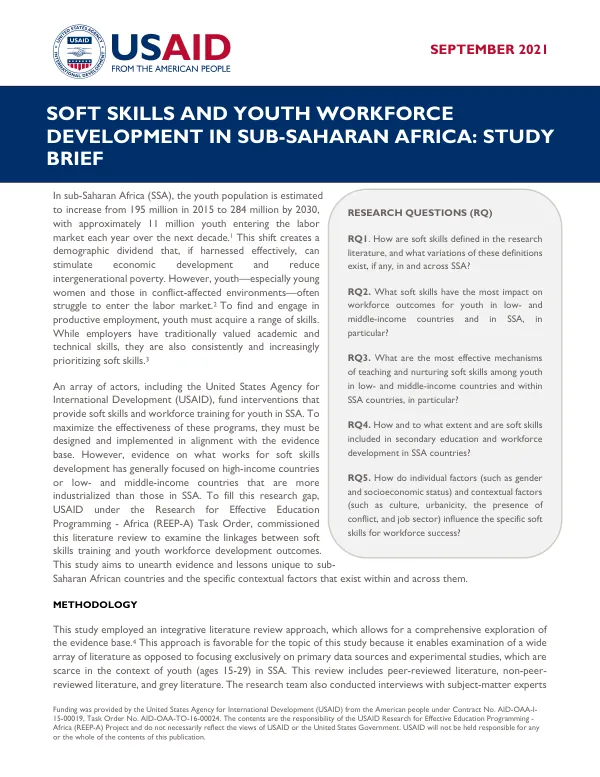
This demographic shift presents a demographic dividend that, if harnessed effectively, can stimulate economic development and reduce intergenerational poverty. However, youth, especially young women and those in conflict-affected environments, often struggle to enter the labor market. To find and engage in productive employment, youth must acquire a range of skills, including soft skills. While employers have traditionally valued academic and technical skills, they are increasingly prioritizing soft skills, such as communication, teamwork, and conflict management. An array of actors, including the United States Agency for International Development (USAID), fund interventions that provide soft skills and workforce training for youth in SSA. The USAID Research for Effective Education Programming - Africa (REEP-A) Project commissioned a literature review to examine the linkages between soft skills training and youth workforce development outcomes in SSA. The study employed an integrative literature review approach, which allowed for a comprehensive exploration of the evidence base. The research team conducted interviews with subject-matter experts involved in research and implementation of soft skills training in SSA and other low- and middle-income countries (LMICs) to uncover additional lessons learned and contextual factors. The literature search returned 177 publications that met the inclusion criteria, with 98 articles focusing on SSA, 30 on LMICs, and 49 covering both SSA and LMICs. The publications included empirical studies, literature reviews, program evaluations, policy documents, and other documents. The review faced several key limitations, including varying definitions and measurements of soft skills across contexts, the reliability and validity of tools that measure soft skills in SSA, and a lack of studies examining causal links between specific soft skills and workforce outcomes. Soft skills are generally considered complementary to "hard skills" that can be job-specific, easily defined, and easily measured. In SSA, various governments and policymakers conceptualize soft skills as an investment in human capital, believing that several key soft skills lead to better governance and equitable development, including problem solving, social awareness, and creativity. Adaptability and resilience in conflict and crisis contexts are also viewed as essential competencies for citizens in the region. The most common methods of measuring soft skills in SSA tend to suffer from biases, such as self-report scales. However, new tools, including anchoring vignettes and situational judgement items, are being adapted for the sub-Saharan context to ensure that they are culturally relevant, reliable, and valid. There is a growing body of research from SSA that demonstrates the impact of soft skills on workforce outcomes for youth, with five workforce outcome categories identified: employment and employability, job performance, wages, entrepreneurship, and financial management. Increased self-confidence and self-efficacy are linked to improving multiple workforce outcomes, including employment, job performance, wages, and entrepreneurship. Goal setting, social skills, work ethic, and time organization can give youth confidence to enter the labor market and enhance their job performance. Communication, teamwork, and conflict management skills improve job performance and increase wages. Personal initiative (PI) training is an effective approach to develop successful entrepreneurship skills linked to increased earnings and business success for adults, which makes it especially promising for youth in SSA. Specific skills linked to workforce outcomes may differ between women and men and across contexts. Research shows that women sometimes benefit more from such training, with leadership, conflict resolution, negotiation, and management skills having long-term positive effects on self-employment, while decision making is linked to increased savings. Soft skills training helps women feel increased control over their lives, improved confidence, and stronger peer and familial relationships, which are particularly important for their economic and social empowerment.