RWANDAN EDUCATION BOARD
Solar-Powered, Technology-Supported Learning in Rwanda
Solar-powered technology is being used to support learning in Rwanda's public primary schools.
3 pages
Sign in to readA free account is required to download.
Abstract
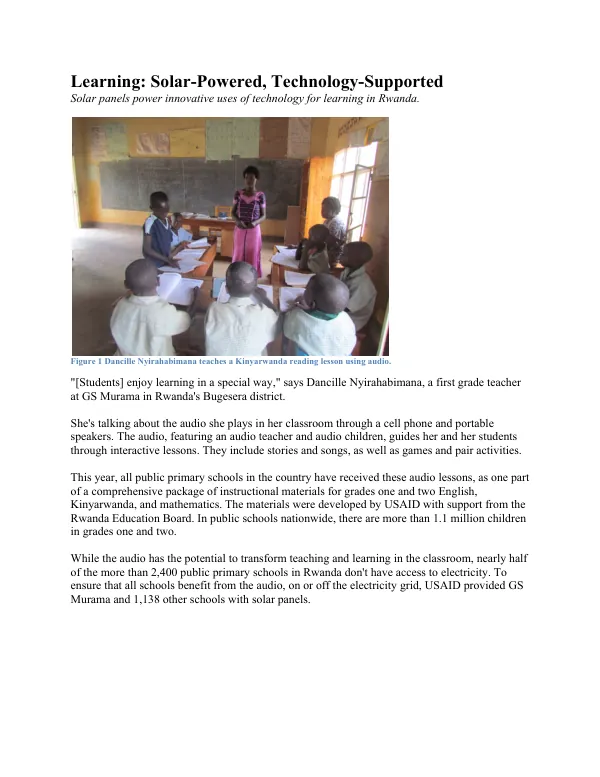
The initiative involves the distribution of audio lessons, developed by USAID in collaboration with the Rwanda Education Board, to all public primary schools nationwide. These audio lessons are designed to guide teachers through model lessons and help them implement instructional practices proven to develop children's literacy and numeracy skills. The audio lessons are part of a comprehensive package of instructional materials for grades one and two English, Kinyarwanda, and mathematics. The materials are intended to support teachers in their classrooms, regardless of location or training. The audio lessons are accompanied by teacher guides and student books with simple, leveled stories. Teachers prepare in advance by listening to the audio for the day's lesson and reviewing the teacher guide. To ensure that all schools can benefit from the audio lessons, USAID provided solar panels to 1,138 public primary schools, including GS Murama in Rwanda's Bugesera district. The solar panels power portable speakers that charge the audio devices, allowing teachers to play the lessons in their classrooms. This technology has the potential to transform teaching and learning in the classroom, particularly in schools without access to electricity. The introduction of the audio lessons has had a positive impact on students and teachers alike. Students appreciate the stories, games, and interactive activities included in the lessons, which help them increase their knowledge and develop their literacy and numeracy skills. Teachers also benefit from the audio lessons, which make their work easier and help them improve their pronunciation in English. The solar-powered technology has enabled teachers to move around the classroom and interact with more children, creating a more engaging and effective learning environment. The initiative has been implemented in over 1,400 public primary schools nationwide, reaching more than 1.1 million children in grades one and two. The solar-powered technology has enabled these schools to access the audio lessons, regardless of their location or access to electricity. The initiative has the potential to improve learning outcomes and increase access to quality education in Rwanda's public primary schools.