MERCY CORPS INTERNATIONAL
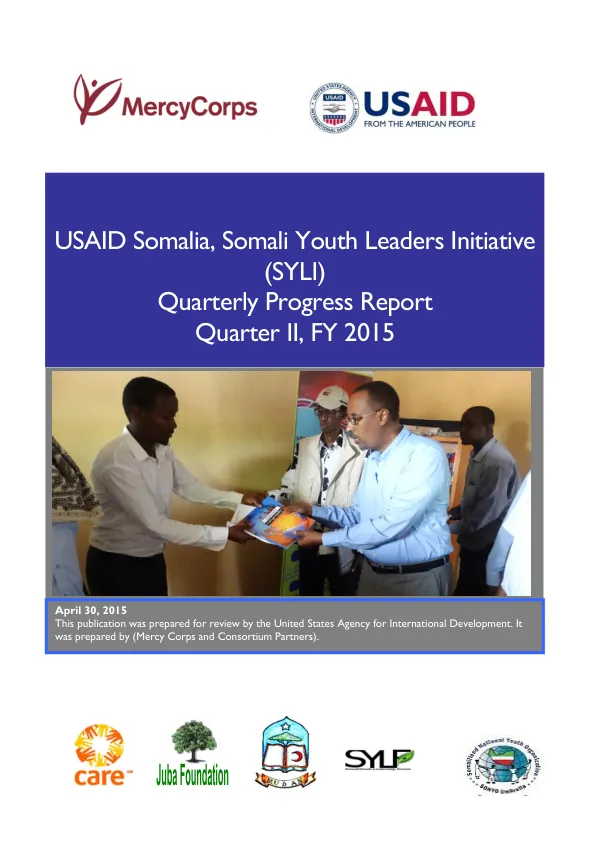
Somali Youth Leaders Initiative (SYLI) FY 2015 Q2 PROGRESS REPORT
Somaliland remained calm during the reporting period, with no significant incidents reported.
2015 · 33 pages
Sign in to readA free account is required to download.
Abstract
However, the forthcoming general elections of June 2015 were a major concern. The Somaliland National Electoral Commission (NEC) announced plans to conduct voter registration for the upcoming elections and set a timeline. The NEC and three political parties met in Hargeisa to discuss the dates to start the groundwork tasks related to the election process. Voter registrations were expected to begin by the end of July 2015 and last for five months. The commission planned to declare the election date after concluding the registration exercise for political parties to hold their respective nominations and campaigns. This delay had the potential for political tension and subsequent election violence in Somaliland. Puntland remained relatively stable during the quarter, with no significant changes in the political, security, and socio-economic settings. However, the security situation in Bossaso remained precarious due to Al-shabab (AS) militancy. The Puntland administration made efforts to decimate AS strength and retain control of the area. The ongoing conflict in Yemen had an effect on Puntland and the general Somalia economy. The Saudi-led military intervention in Yemen restricted the movement of commercial boats to and from Yemen across the Red Sea. Many business companies in Puntland experienced a decline in business activities due to the import of basic food and other essential commodities from Yemen. The influx of Somali and Yemeni refugees escaping the conflict in Yemen further complicated the situation, as there were no major ongoing emergency response mechanisms to assist and re-settle the refugees. The Federal Government of Somalia showed commitment towards the establishment of a new regional administration (Central State) for Mudug and Galgadud regions. The Somali President visited the region twice within the quarter to build consensus among the long-divided communities in central Somalia and to help them decide their future as they continued setting up a roadmap towards the attainment of a fully functioning regional administration in accordance with the country's federal constitution. The final conference that would culminate in the formation of the Central State was planned for April 2015 and may possibly run for a month. The Galmudug regional administration operationalized Hobyo Port in the Mudug region, with imports of goods already flowing in smoothly from mid-March 2015. A fundraising initiative was organized by local businessmen, women, elders, and professionals from Galmudug to rehabilitate the road linking Galkacayo to Hobyo to ease the flow of goods smoothly between the two cities. The road in its current condition remained a major hindrance to transportation and business. Security-wise, control of Guriceel town remained a source of tension between the Somali National Army (SNA) and Ahli Sunnah Wa Jimaah (ASWJ) forces in Galgadud region. Scarce resources, including water and pasture, and long-standing grievances relating to land disputes triggered frequent inter and intra-clan conflicts in the Galgadud and Mudug regions, claiming lives and destroying properties. The recently appointed Prime Minister Omar Abdirashid Sharmarke appointed his cabinet ministers following weeks of internal dispute and negotiations due to competing and divergent interests among the different groups in Somalia. The 20-member cabinet appointed reflected an inclusive government with the political faces of Somalia, although several ministers were retained from the previous government. The announcement came on the heels of the Prime Minister dismissing two nominated cabinet ministers before even presenting them to the parliament for vetting due to stiff resistance within the parliament. It was the first time that three female ministers joined the cabinet, holding key ministries such as Education, Health, and Women's Affairs.