MERCY CORPS INTERNATIONAL
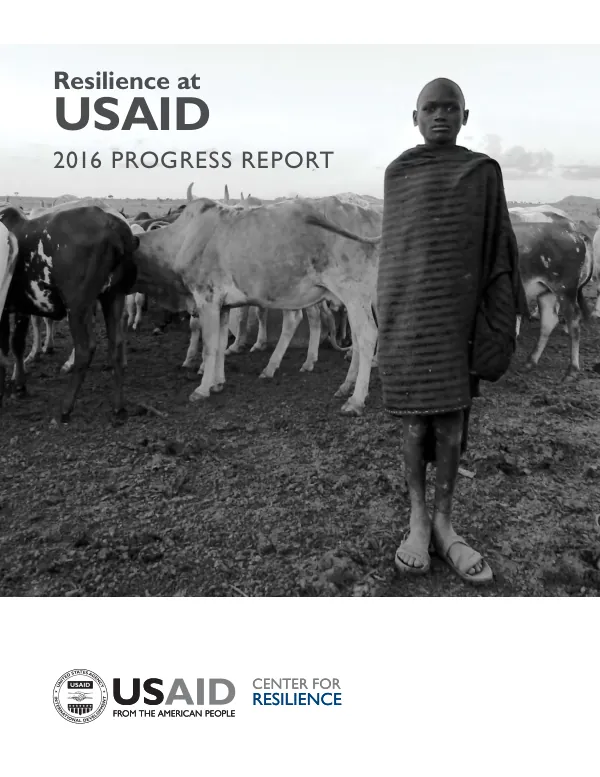
Resilience at USAID 2016 Progress Report
The Resilience Leadership Council, co-chaired by Beth Dunford and Gregory C.
2016 · 24 pages
Sign in to readA free account is required to download.
Abstract
Gottlieb, has released the inaugural Resilience in USAID Progress Report. This report highlights the agency's efforts to build resilience to recurrent crises in Africa and Asia. The report emphasizes the importance of resilience in the face of climate change, price shocks, health crises, and conflict. The report notes that the large-scale drought emergencies in the Horn of Africa and Sahel in 2011-2012 led to a collective recognition of the need to address recurrent crises. USAID defines resilience as the ability of people, households, communities, countries, and systems to mitigate, adapt to, and recover from shocks and stresses in a manner that reduces chronic vulnerability and facilitates inclusive growth. The report highlights the agency's efforts to institutionalize resilience, including the establishment of a cross-bureau Resilience Leadership Council, a Center for Resilience, and a Resilience Coordinator position in USAID Washington. The report also emphasizes the importance of partnerships, including regional partnerships in the Horn of Africa and Sahel/West Africa, as well as the Global Resilience Partnership between USAID, the Rockefeller Foundation, and the Swedish International Development Cooperation Agency (Sida). The report focuses on eight focus countries, including Kenya, Ethiopia, Somalia, Uganda, Burkina Faso, Niger, Mali, and Nepal. In these countries, USAID has invested in programs aimed at reducing and managing risk, building adaptive capacity, and facilitating inclusive growth. The report highlights the progress made in these countries, including the establishment of resilience portfolios, the development of risk and resilience measurement tools, and the implementation of programs aimed at reducing chronic vulnerability. The report also emphasizes the importance of resilience in achieving the Sustainable Development Goals (SDGs) and ending extreme poverty. The report notes that resilience is a necessary condition for reducing and ultimately eliminating poverty, hunger, malnutrition, and humanitarian assistance needs in complex risk environments. In the wake of the current El Niño weather phenomenon, the report outlines USAID's vision for expanding its efforts to build resilience. The report emphasizes the need to invest in programs aimed at reducing and managing risk, building adaptive capacity, and facilitating inclusive growth. The report also highlights the importance of partnerships and institutionalizing resilience within USAID. The report concludes by emphasizing the importance of resilience in addressing the complex challenges facing the world today. The report notes that resilience is a necessary condition for reducing and ultimately eliminating poverty, hunger, malnutrition, and humanitarian assistance needs in complex risk environments. The report emphasizes the need for continued investment in programs aimed at building resilience and achieving the SDGs.