FHI 360
TB CARE Annual Work Plan and Budget
The Challenge TB project in Cambodia, led by FHI 360, has made significant progress in its second year.
2016 · 33 pages
Sign in to readA free account is required to download.
Abstract
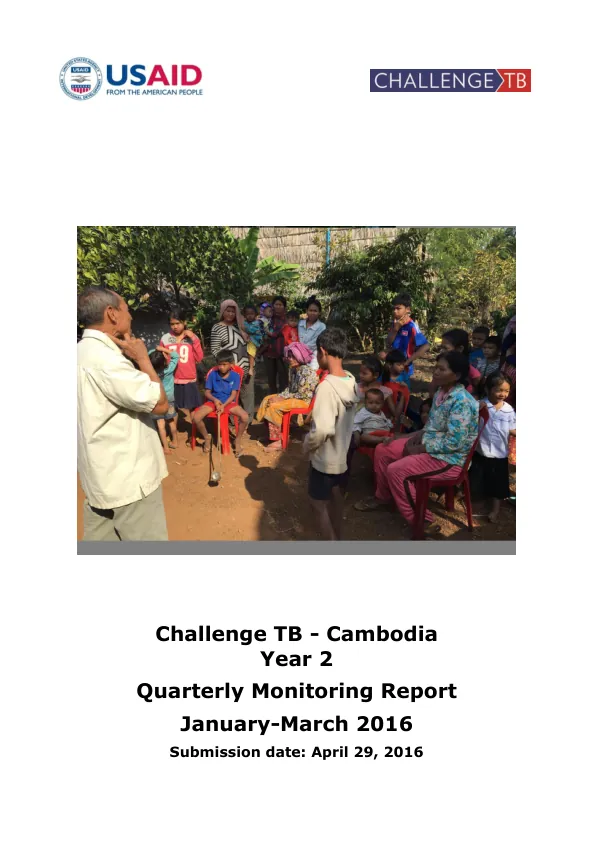
The project's work plan, spanning from October 2015 to September 2016, focuses on operational research, educational tools development, and TB symptom inclusion in general medical triage forms. Operational research is a key component of the project, with a study protocol developed for "Active case finding for tuberculosis in Cambodia: A cluster randomized controlled trial." The study aims to determine the effectiveness and additional yield of a house-to-house TB screening approach with on-site diagnosis by GeneXpert testing and Chest X-Ray added to the current approach. The study will be implemented in 60 Health Centers, with 30 in the intervention arm and 30 in the control arm. The study population consists of elderly individuals aged 55 and above, with approximately 69,000 participants enrolled. In the area of educational tools development, two patient-education posters were developed and field-tested during the reporting period. The posters aim to instruct presumptive TB patients on how to produce good quality sputum and increase knowledge and awareness of TB symptoms among the general population. The posters will be displayed in communities, health centers, referral hospitals, and public places to promote TB awareness and health-seeking behavior. The project has also revised the general medical triage form to include four TB symptoms: cough, fever, weight loss, and night sweats. The revised form has been approved by the Ministry of Health and will be used at referral hospitals to improve TB case findings and notification. A USAID visit to the Challenge TB project took place from March 8 to 9, 2016, with the objective of finalizing the Mission's TB strategy for Cambodia. The project presented its activities and key achievements, including contributing 20% of TB case notifications to the national TB case notification in 2015, despite having a project geographic coverage of only 10%. Technical and administrative challenges were identified during the reporting period, including patient referral to referral hospitals, improvement of CXR reading skills, and low MDR case notification. To address these challenges, the project will continue to work with health centers to identify local private transportation for patient referral, improve CXR reading skills through training and technical support, and revisit the current support system for MDR case notification. The project's progress in the enabling environment is also noteworthy, with the public-private mix (PPM) TB DOTS approach implemented, refined, and planned to expand to other operational districts. However, the PPM activity was not accomplished in the first quarter of 2016 due to ongoing negotiations and establishment of MOUs with private providers. Overall, the Challenge TB project in Cambodia has made significant progress in its second year, with a focus on operational research, educational tools development, and TB symptom inclusion in general medical triage forms. The project continues to address technical and administrative challenges to improve TB case findings and notification in the country.
Related documents