INTERNATIONAL RICE RESEARCH INSTITUTE (IRRI)
Source of output growth in Asian food grains
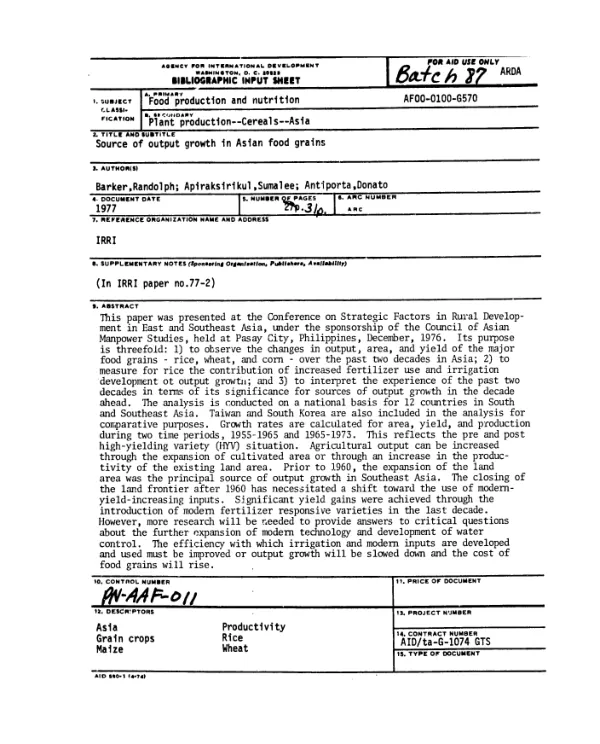
This paper was presented at the Conference on Strategic Factors in Rural Development in East and Southeast Asia, under the sponsorship of the Council of Asian Manpower Studies, held at Pasay City, Philippines, December 1976.
Barker, Randolph; Apiraksirikul, Sumalee +1 more · 1970
Sign in to readA free account is required to download.
Abstract
Its purpose is threefold: (1) to observe the changes in output, area, and yield of the major food grains -- rice, wheat, and corn -- over the past two decades in Asia; (2) to measure for rice the contribution of increased fertilizer use and irrigation development of output growth; and (3) to interpret the experience of the past two decades in terms of its significance for sources of output growth in the decade ahead. The anlysis is conducted on a national basis for 12 countries in South and Southeast Asia. Taiwan and South Korea are also included in the analysis for comparative purposes. Growth rates are calculated for area, yield, and production during two time periods, 1955-1965 and 1965-1973. This reflects the pre and post high-yielding variety (HYV) situation. Agricultural output can be increased through the expansion of cultivated area or through an increase in the productivity of the existing land area. Prior to 1960, the expansion of the land area was the principal source of output growth in Southeast Asia. The closing in of the land frontier after 1960 has necessitated a shift toward the use of modern-yield-increasing inputs. Significant yield gains were achieved through the introduction of modern fertilizer responsive varieties in the last decade. However, more research will be needed to provide answers to critical questions about the further expansion of modern technology and development of water control. The efficiency with which irrigation and modern inputs are developed and used must be improved or output growth will be slowed down and the cost of food grain will rise.
Related documents