INTERNATIONAL RICE RESEARCH INSTITUTE (IRRI)
WORLD RICE SITUATION, 1977-78
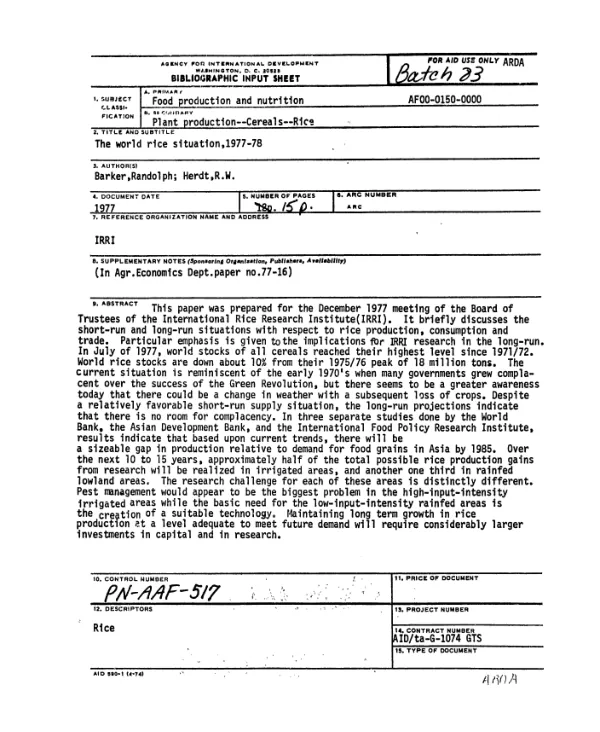
This paper was prepared for the December l977 meeting of the Board of Trustees of the International Rice Research Institute (IRRI).
BARKER, RANDOLPH; HERDT, ROBERT W. · 1970
Sign in to readA free account is required to download.
Abstract
It briefly discusses the short-run and long-run situations with respect to rice production, consumption and trade. Particular emphasis is given to the implications for IRRI research in the long-run. In July of l977, world stocks of all cereals reached their highest level since l97l/72. World rice stocks are down about l0 percent from their l975/76 peak of l8 million tons. The current situation is reminiscent of the early l970"s when many governments grew complacent over the success of the Green Revolution, but there seems to be a greater awareness today that there could be a change in weather with a subsequent loss of crops. Despite a relatively favorable short-run supply situation, the long-run projections indicate that there is no room for complacency. In three separate studies done by the World Bank, the Asian Development Bank, and the International Food Policy Research Institute, results indicate that based upon current trends, there will be a sizable gap in production relative to demand for food grains in Asia by l985. Over the next l0 to l5 years, approximately half of the total possible rice production gains from research will be realized in irrigated areas, and another one third in rainfed lowland areas. The research challenge for each of these areas is distinctly different. Pest management would appear to be the biggest problem in the high-input-intensity irrigated areas while the basic need for the low-input-intensity rainfed areas is the creation of a suitable technology. Maintaining long-term growth in rice production at a level adequate to meet future demand will require considerably larger investments in capital and in research.