USAID DEC
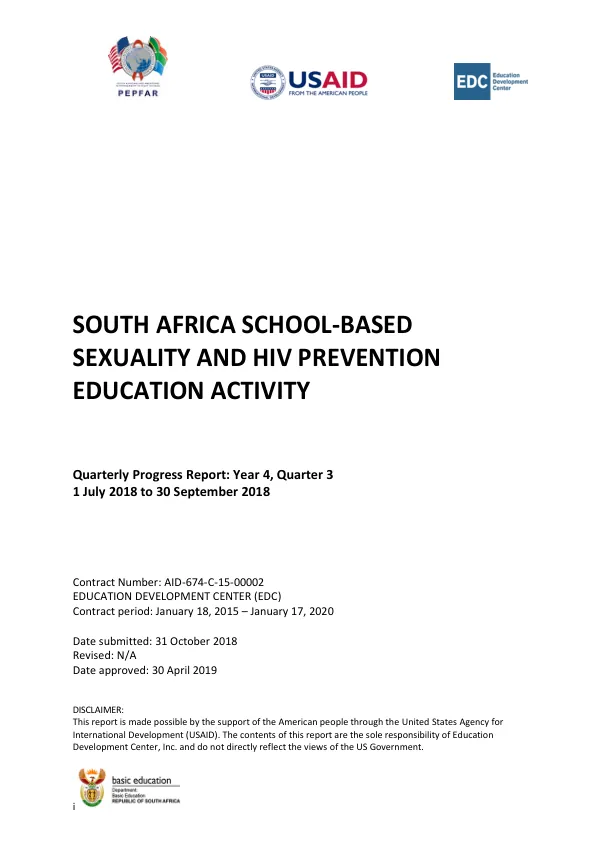
South Africa School-Based Sexuality and HIV Prevention Education Activity Quarterly Progress Report: Year 4, Quarter 3
Sign inCENTER FOR EDUCATIONAL DEVELOPMENT
South Africa School-Based Sexuality and HIV Prevention Education Activity Quarterly Progress Report: Year 4, Quarter 3
The South Africa School-Based Sexuality and HIV Prevention Education Activity is a five-year initiative implemented by the Education Development Center, Inc.
2018 · 23 pages
Sign in to readA free account is required to download.
Abstract
(EDC) in consortium with partners Health Economics and HIV and AIDS Research Division (HEARD). The Activity aims to reduce new HIV infections in students and teachers by assisting the Department of Basic Education (DBE) to implement high-quality, evidence-informed sexuality and HIV prevention education programs. The Activity focuses on five of the nine provinces in South Africa, with a specific emphasis on the seven priority districts for PEPFAR support. These districts have the highest HIV infection rate and disease burden. The objectives of the Activity are to increase the number of teachers qualified to teach sexuality education, strengthen DBE's capacity to provide education and training for teachers, improve the quality of school-based sexuality and HIV education programs, increase DBE capacity to work in partnership with the Department of Health, and improve systems to evaluate the effectiveness of the sexuality and HIV education program. During the 1 July 2018 to 30 September 2018 reporting period, the Activity made significant progress towards its objectives. EDC and partner HEARD engaged relevant DBE national, provincial, and district staff, as well as other supporting stakeholders, to implement activities during this period. The districts and provinces took a more active role in organizing and supporting implementation, demonstrating a strong sense of ownership from the education system. One of the major achievements during this period was the pilot training of educators for Grades 4-6 and 10-11 on the new School Learning Program (SLP) materials. A total of 918 educators were trained in all 11 Activity districts, with the lessons listed in Annex C. The training was conducted in all five provinces, with the following dates: Free State (16-18 August 2018 and 23-25 August 2018), Gauteng (15-17 August 2018 and 23-25 August 2018), KwaZulu-Natal (15-17 August 2018 and 24-26 August 2018), Mpumalanga (3-5 August 2018 and 23-25 August 2018), and Western Cape (17-19 August 2018 and 24-26 August 2018). The Activity also conducted classroom observations of all the lessons to determine whether they work in the classroom situation in terms of content, methodology, time allocated for activities, assessment, and resources suggested. The team ensured that both rural and urban classrooms were observed. Additionally, data was collected on learners reached during the July to September period for Grades 7-9 and the new grades (4-6 and 10-11). The Activity also focused on strengthening DBE's capacity to provide education and training for teachers to teach sexuality and HIV education lessons in the classroom. This included training of HODs in Gauteng to support implementation in schools, as well as piloting the new SLPs for Grades 4, 5, 6, 10, and 11. The Activity also made progress in improving the quality of school-based sexuality and HIV education programs. This included printing and delivering draft SLPs to educators and learners, as well as conducting meetings with provinces to ensure that the pilot implementation for the new grades is a success and that the provinces start planning for implementation in 2019 for all 9 grades from Grades 4 to Grade 12. The Activity also supported district and provincial officials from project sites who attended a professional development of provincial and district officials in Cape Town. Additionally, the Activity drafted the 2019 workplan with DBE and USAID, categorizing the five Activity objectives under three of several PEPFAR strategic objectives that have been identified for COP 2018. The Activity also made progress in improving systems to evaluate the effectiveness of the sexuality and HIV education program. This included collecting data on learners reached during the July to September period for Grades 7-9 and the new grades (4-6 and 10-11), as well as conducting classroom observations of all the lessons to determine whether they work in the classroom situation in terms of content, methodology, time allocated for activities, assessment, and resources suggested. Overall, the Activity made significant progress towards its objectives during the 1 July 2018 to 30 September 2018 reporting period, with a strong sense of ownership from the education system and a focus on improving the quality of school-based sexuality and HIV education programs.