USAID DEC
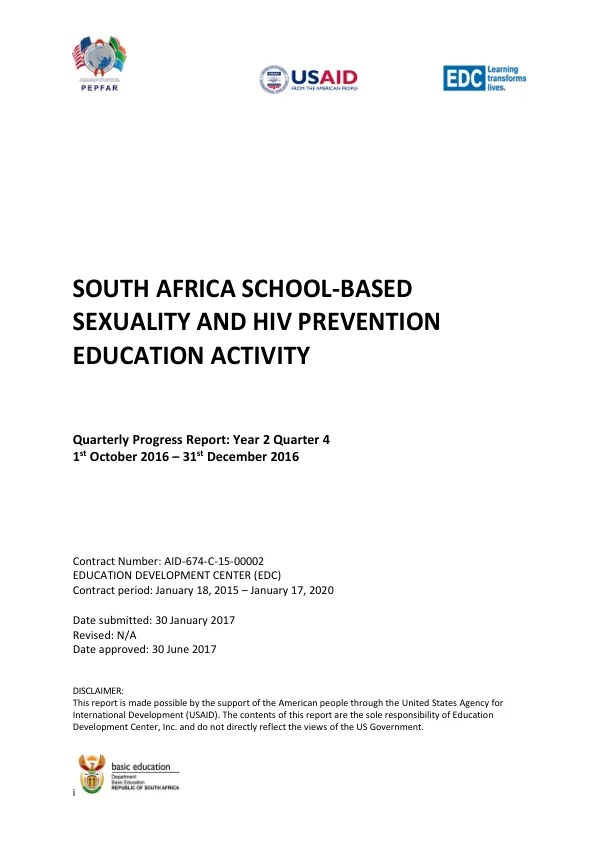
South Africa School-Based Sexuality and HIV Prevention Education Activity Quarterly Progress Report: Year 2 Quarter 4
Sign inCENTER FOR EDUCATIONAL DEVELOPMENT
South Africa School-Based Sexuality and HIV Prevention Education Activity Quarterly Progress Report: Year 2 Quarter 4
The South Africa School-Based Sexuality and HIV Prevention Education Activity aims to provide adolescents with knowledge, skills, and efficacy to make informed decisions about their sexuality, reproductive health, sexually transmitted infections (STIs), and lifestyle in a world affected by HIV.
2016 · 31 pages
Sign in to readA free account is required to download.
Abstract
The goal of the activity is to reduce new HIV infections in students and teachers by assisting the Department of Basic Education (DBE) to implement high-quality, evidence-informed sexuality and HIV prevention education programs. The activity targets in-school adolescent girls and boys, aged 10-19 or Grades 4-12. Key activities during the reporting period from October to December 2016 included training Grade 7, 8, and 9 educators on Scripted Lesson Plans (SLPs) using training materials approved by the DBE in various districts across South Africa. The training focused on topics such as comprehensive sexuality education, HIV prevention, and life skills. EDC also conducted a training review session to reflect on the delivery of the training using the materials approved by the DBE in September 2016. Additionally, the organization revised training manuals for key stakeholders in the implementation of the Activity based on discussions with the DBE. These manuals included topics such as school governing body sensitization, school management team orientation, and coaching and mentoring training for Life Orientation (LO) Heads of Department. The activity also focused on sensitizing School Governing Bodies (SGBs) of schools in Mpumalanga Province and KwaZulu Natal Province. These sensitization workshops were followed by parent advocacy sessions conducted by SGB members who attended the workshops. On-site support was provided in Sexuality Education (SE) activities to schools and the revival of School-Based Support Teams (SBST) in three schools in Bohlabela District. EDC analyzed and preliminarily reported on data from educator training workshops and School Governing Body (SGB) sessions. The organization also prepared and submitted proofs and mock books of Grade 7, 8, and 9 educator guides and learner workbooks to the DBE for review and approval. Furthermore, EDC completed and submitted draft IMP and FET Development Process Document to DBE and finalized reports on various topics, including a bibliography of evaluated curricula for Grade 10-12 and evidence update and technical guidance for the integration of gender and power into scripted lesson plans. Communication between DBE, USAID, EDC, and partners continues to mature, with regular monthly and quarterly meetings ensuring that all stakeholders are on the same page and able to progress. The activity implementation focus is in five of the nine provinces and in eight of the 27 identified priority districts for PEPFAR support in South Africa. The objectives for the school-based sexuality and HIV prevention activity are to increase the number of teachers qualified to teach sexuality education, strengthen DBE's capacity to provide education and training for teachers, improve the quality of school-based sexuality and HIV education programs, increase DBE capacity to work in partnership with the Department of Health, and improve systems to evaluate the effectiveness of the sexuality and HIV education program. EDC and partners engaged relevant DBE national, provincial, and district staff as well as other stakeholders to achieve these objectives. The activity targets in-school adolescent girls and boys, aged 10-19 or Grades 4-12, and aims to reduce new HIV infections in students and teachers by assisting the DBE to implement high-quality, evidence-informed sexuality and HIV prevention education programs. The activity implementation focus is in five of the nine provinces and in eight of the 27 identified priority districts for PEPFAR support in South Africa. These districts have the highest HIV infection rate and disease burden. The activity targets in-school adolescent girls and boys, aged 10-19 or Grades 4-12, and aims to reduce new HIV infections in students and teachers by assisting the DBE to implement high-quality, evidence-informed sexuality and HIV prevention education programs. EDC and partners engaged relevant DBE national, provincial, and district staff as well as other stakeholders to achieve the objectives of the activity. The activity implementation focus is in five of the nine provinces and in eight of the 27 identified priority districts for PEPFAR support in South Africa. These districts have the highest HIV infection rate and disease burden.
Related documents