USAID. BUR. FOR AFRICA. OFC. OF SOUTHERN AFRICAN AFFAIRS
South African bursaries
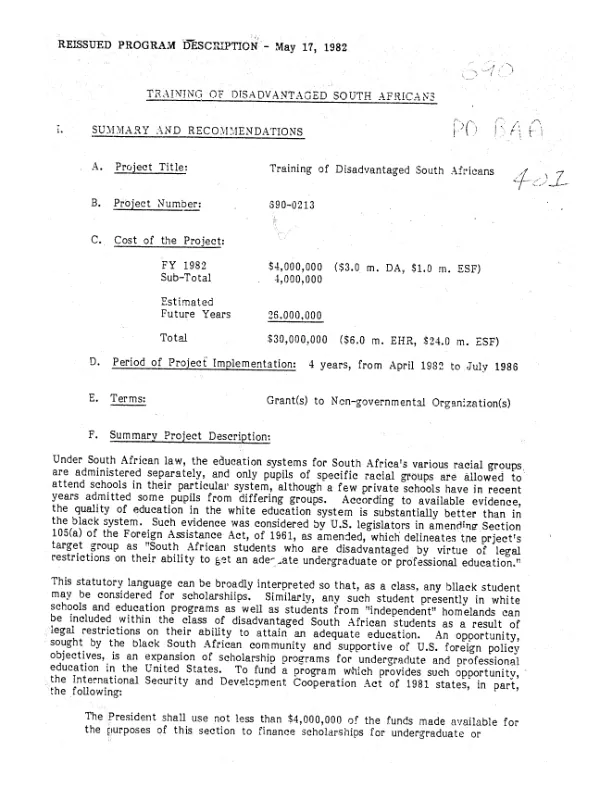
Project, follow-on to project 6900213, to help meet the need for trained black South Africans by financing undergraduate training for them at South African schools.
1985
Sign in to readA free account is required to download.
Abstract
A National Committee of black leaders, largely from the South African Institute of Race Relations (SAIRR) and the Educational Opportunities Council (EOC), will implement the project. Undergraduate scholarships will be awarded to black South Africans to attend a national university or a technical or trade school of their choice. The amount awarded will vary, depending on the type of school attended (i.e., an integrated university, a black university, or the University of South Africa - a correspondence school), as well as on student status (full- or part-time) and financial need. As in project 6900213 (which is currently funding U.S. training for black South Africans), studies under this project will be completed in the natural and social sciences, with the addition of areas of emerging importance to South African blacks such as journalism and mass media. Even though a bachelor"s degree is normally attained in South Africa in 3 years, the scholarship will cover a 5-year period to allow for completion of the degree plus any of the following: additional studies to obtain an Honors degree; a supplementary education or "bridging" period; and any other considerations which may affect the length of the student"s program (e.g., student boycotts or unrest). The remedial or "bridging" program is intended to counteract the high attrition rate (60%) among first-year black students and to help ease students" academic transition. The program will be implemented on a case by case basis and will take various forms, e.g., 3 or 4 weeks of intensive study before the beginning of the academic year, tutorial help for small groups, or individual help from upper classmen. (In 1986 the South African Council on Higher Education will receive U.S. private sector help for a much more ambitious "bridging" effort.) The project will also finance a limited number of graduate scholarships in the four areas where the need for trained blacks is the most critical: medicine, dentistry, law, and engineering. A total of about 700 black South Africans will be educated under the project.