INTERNATIONAL ORGANIZATION FOR MIGRATION
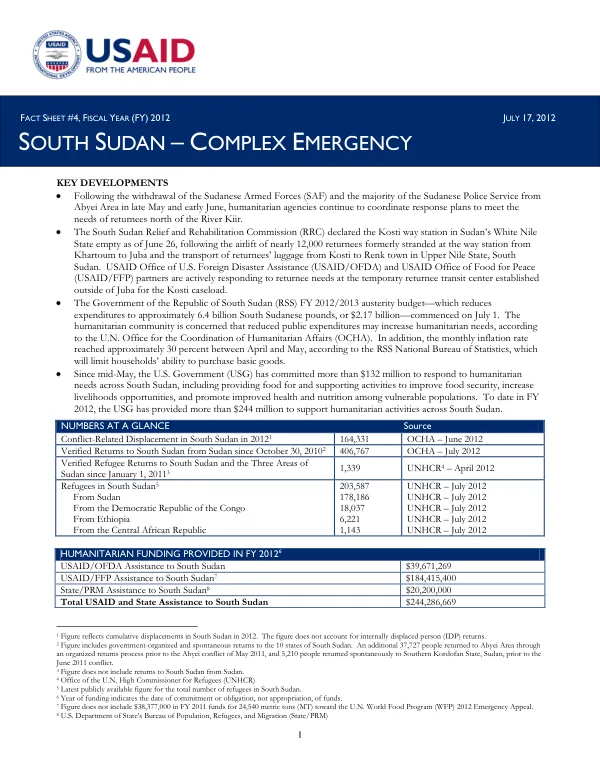
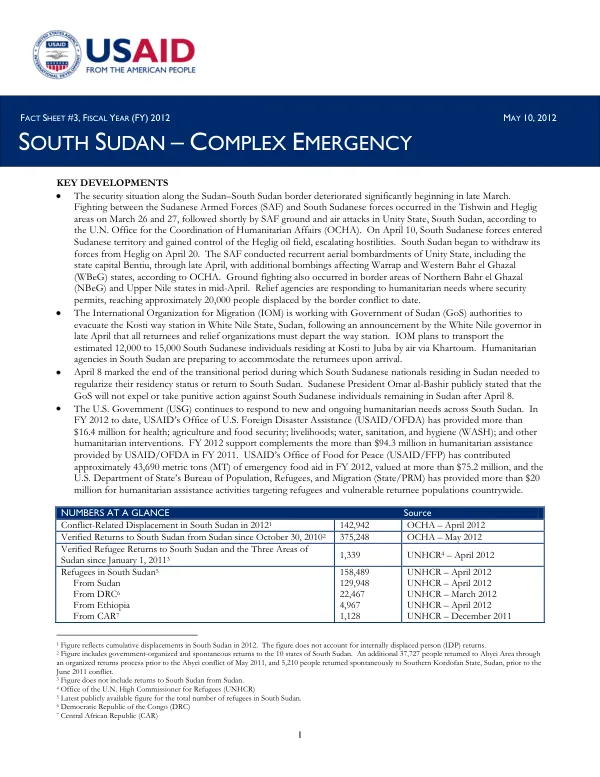
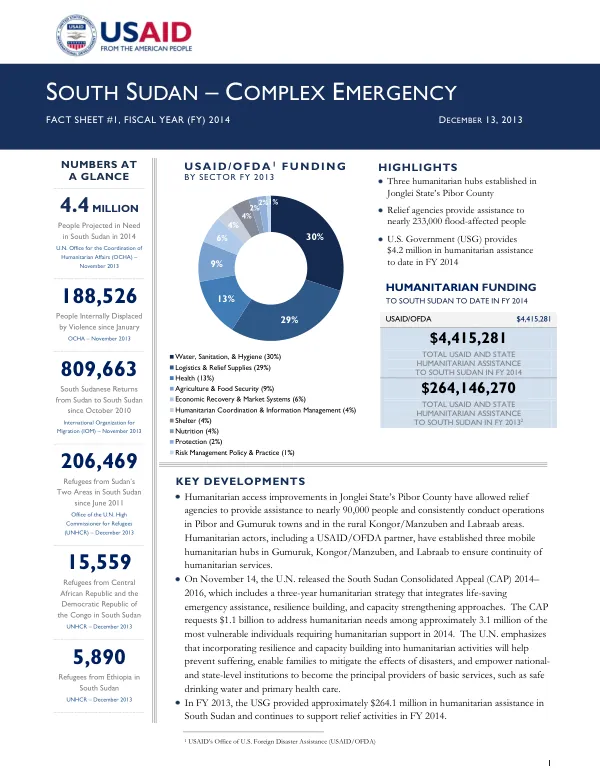
SOUTH SUDAN – COMPLEX EMERGENCY FACT SHEET #1, FISCAL YEAR (FY) 2014
Humanitarian efforts in South Sudan have been ongoing in response to the complex emergency situation.
2014 · 6 pages
Sign in to readA free account is required to download.
Abstract
In Jonglei State's Pibor County, humanitarian access has expanded, allowing relief agencies to consistently provide assistance in Pibor and Gumuruk towns, as well as in the rural areas of Kongor/Manzuben and Labraab. Relief agencies have provided aid to nearly 90,000 people, the majority of whom were displaced by violence since March in Pibor County, according to the U.N. Humanitarian organizations have established three mobile humanitarian hubs in Pibor County, providing accommodation and office space for aid workers to support ongoing relief operations. The mobile hubs, currently located in Gumuruk town, Kongor/Manzuben, and Labraab, will ensure the continuity of urgent humanitarian services by providing basic infrastructure for field-based relief operations in towns and remote areas where humanitarian infrastructure was destroyed or damaged by fighting, according to the U.N. The U.N. and other humanitarian organizations are actively preparing for the unique set of challenges and opportunities presented by the dry season, which is approaching. The dry season, when roads become more passable for civilian migrations and armed group movements, could affect humanitarian operations. Relief agencies have been working to provide emergency medical care, food supplies, relief items, and water, sanitation, and hygiene (WASH) support in accessible areas. Humanitarian funding has been provided by the U.S. Government (USG) to support relief efforts in South Sudan. In FY 2013, the USG provided approximately $264.1 million in humanitarian assistance in South Sudan, and in FY 2014, the USG has provided $4.2 million in humanitarian assistance to date. The USG has also provided funding to support basic facilities for the humanitarian hubs, including the construction of latrines, bathing facilities, and temporary shelters, and the deployment of experienced surge capacity personnel from INTERSOS to Kongor/Manzuben. In addition to the humanitarian efforts in Jonglei State, relief agencies have also been working to provide assistance to flood-affected communities in Northern Bahr el Ghazal (NBeG) and Warrap states. Through USAID/OFDA's Rapid Response Fund (RRF), four local South Sudanese non-governmental organizations (NGOs) have received nearly $337,000 to provide health care services and WASH assistance for flood-affected communities.