INTERNATIONAL COMMITTEE FOR THE RED CROSS
SOUTH SUDAN COMPLEX EMERGENCY
The security situation along the Sudan-South Sudan border deteriorated significantly beginning in late March.
2012 · 6 pages
Sign in to readA free account is required to download.
Abstract
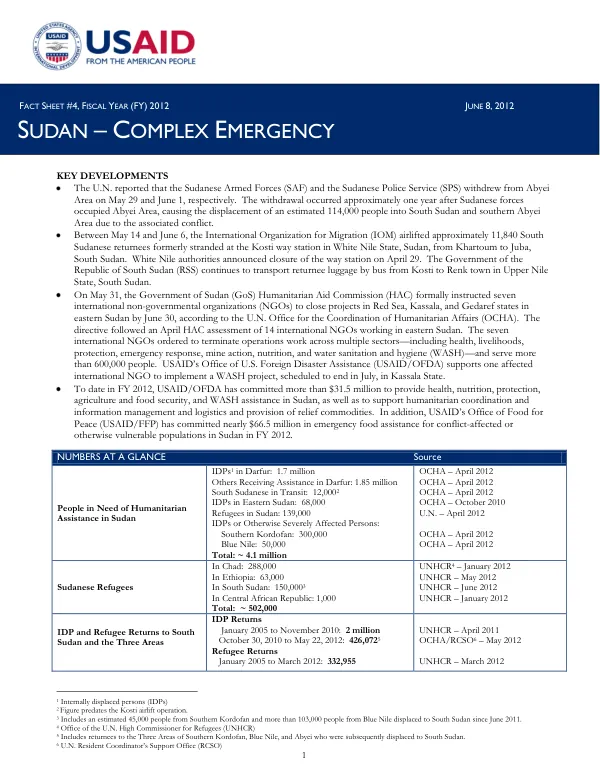
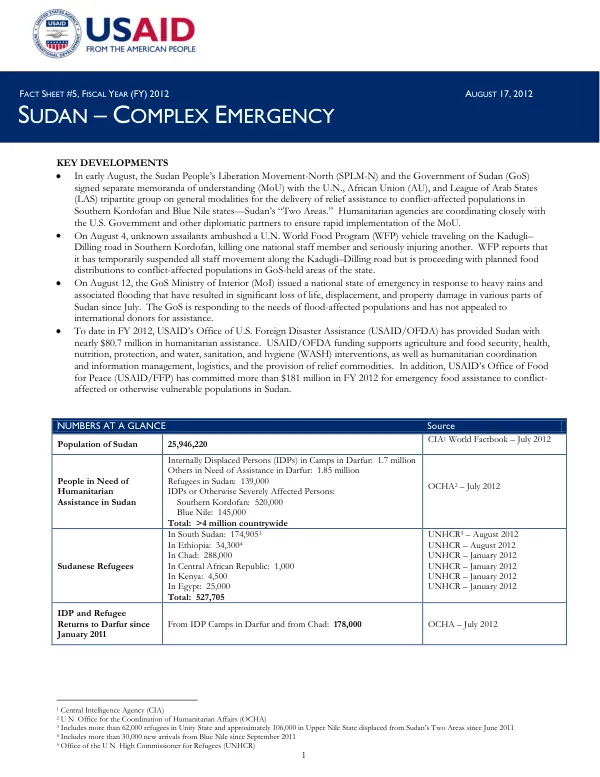
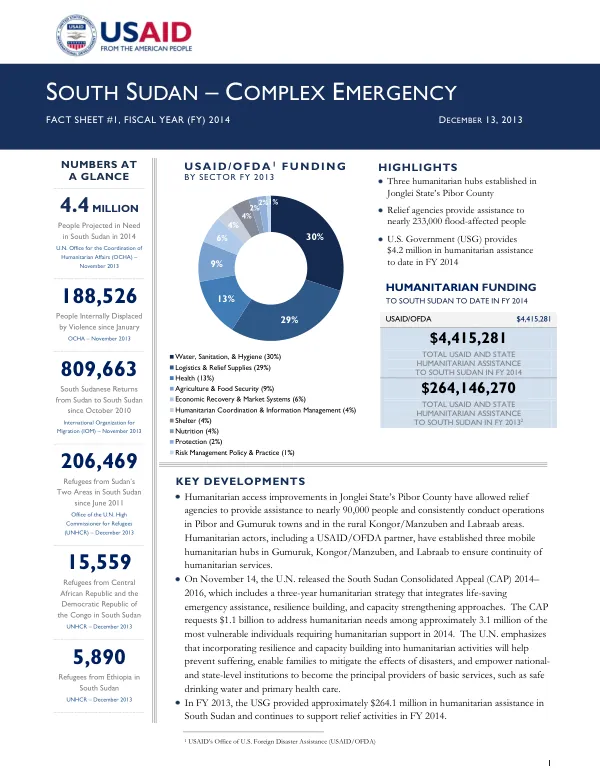
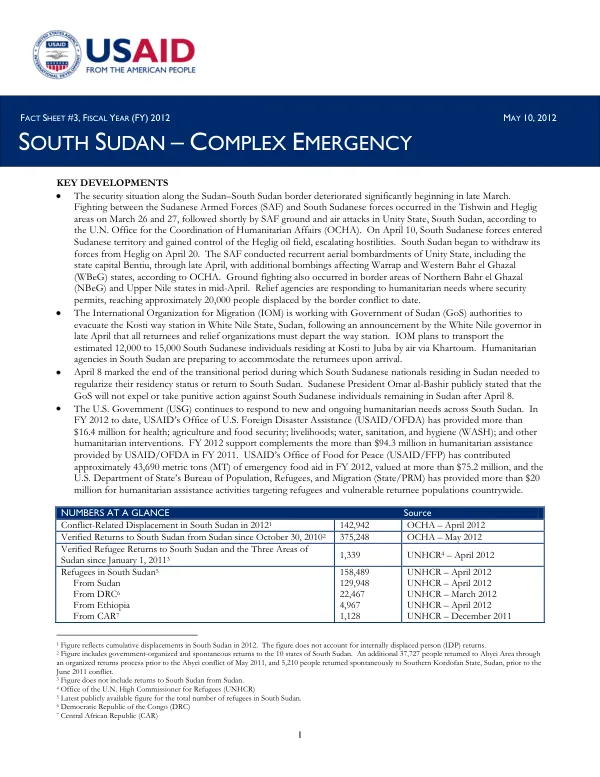
Fighting between the Sudanese Armed Forces (SAF) and South Sudanese forces occurred in the Tishwin and Heglig areas on March 26 and 27, followed shortly by SAF ground and air attacks in Unity State, South Sudan, according to the U.N. Office for the Coordination of Humanitarian Affairs (OCHA). On April 10, South Sudanese forces entered Sudanese territory and gained control of the Heglig oil field, escalating hostilities. South Sudan began to withdraw its forces from Heglig on April 20. The SAF conducted recurrent aerial bombardments of Unity State, including the state capital Bentiu, through late April, with additional bombings affecting Warrap and Western Bahr el Ghazal (WBeG) states, according to OCHA. Ground fighting also occurred in border areas of Northern Bahr el Ghazal (NBeG) and Upper Nile states in mid-April. The International Organization for Migration (IOM) is working with Government of Sudan (GoS) authorities to evacuate the Kosti way station in White Nile State, Sudan, following an announcement by the White Nile governor in late April that all returnees and relief organizations must depart the way station. IOM plans to transport the estimated 12,000 to 15,000 South Sudanese individuals residing at Kosti to Juba by air via Khartoum. Humanitarian agencies in South Sudan are preparing to accommodate the returnees upon arrival. April 8 marked the end of the transitional period during which South Sudanese nationals residing in Sudan needed to regularize their residency status or return to South Sudan. Sudanese President Omar al-Bashir publicly stated that the GoS will not expel or take punitive action against South Sudanese individuals remaining in Sudan after April 8. The U.S. Government (USG) continues to respond to new and ongoing humanitarian needs across South Sudan. In FY 2012 to date, USAID's Office of U.S. Foreign Disaster Assistance (USAID/OFDA) has provided more than $16.4 million for health; agriculture and food security; livelihoods; water, sanitation, and hygiene (WASH); and other humanitarian interventions. FY 2012 support complements the more than $94.3 million in humanitarian assistance provided by USAID/OFDA in FY 2011. USAID's Office of Food for Peace (USAID/FFP) has contributed approximately 43,690 metric tons (MT) of emergency food aid in FY 2012, valued at more than $75.2 million, and the U.S. Department of State's Bureau of Population, Refugees, and Migration (State/PRM) has provided more than $20 million for humanitarian assistance activities targeting refugees and vulnerable returnee populations countrywide. The conflict-related displacement in South Sudan in 2012 has resulted in a significant number of people being displaced. According to OCHA, 142,942 people were displaced in South Sudan in 2012. The verified returns to South Sudan from Sudan since October 30, 2010, total 375,248 people, according to OCHA. The verified refugee returns to South Sudan and the Three Areas of Sudan since January 1, 2011, total 1,339 people, according to the UNHCR. The refugees in South Sudan, as of April 2012, total 158,489 people, with 129,948 from Sudan, 22,467 from the Democratic Republic of the Congo (DRC), 4,967 from Ethiopia, and 1,128 from the Central African Republic (CAR), according to the UNHCR. The humanitarian funding provided in FY 2012 for South Sudan totals $111,836,645, with USAID/OFDA contributing $16,400,645, USAID/FFP contributing $75,236,000, and State/PRM contributing $20,200,000. The U.S. Government continues to respond to the complex emergency in South Sudan, with a focus on providing humanitarian assistance to those affected by the conflict. The security situation along the border remains volatile, with ongoing fighting and aerial bombardments affecting civilians and humanitarian personnel. The humanitarian community continues to respond to the needs of those affected, with a focus on providing life-saving assistance and protecting civilians from harm.
Related documents