USAID. MISSION TO BOTSWANA
Southern Africa agricultural research management training (ARMT)
Summarizes interim impact assessment of a project to strengthen the management and institutional capacities of national agricultural research systems (NARS) in southern Africa.
1994
Sign in to readA free account is required to download.
Abstract
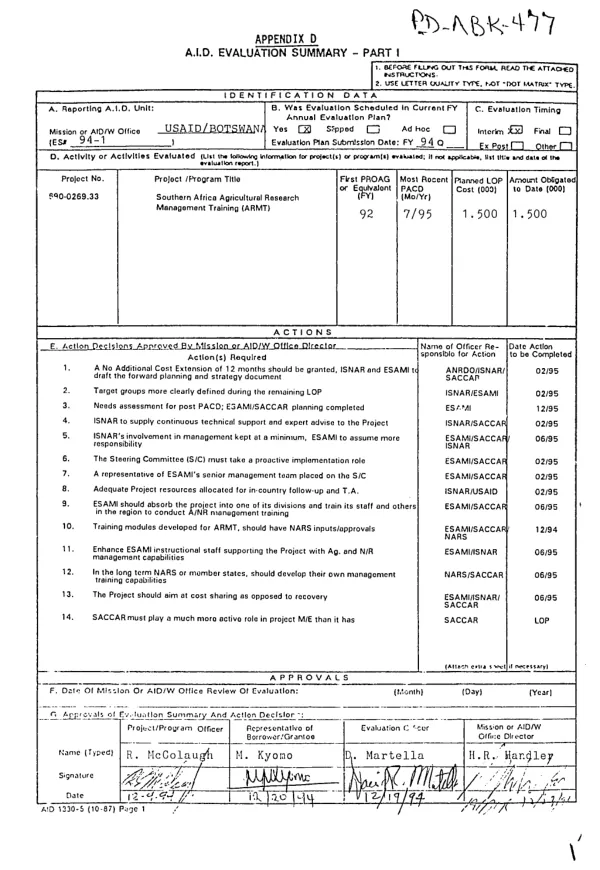
The evaluation covered the period 1986-94. The project is being implemented by the South African Center for Cooperation in Agricultural Research and Training (SACCAR), the Eastern and Southern Africa Management Institute (ESAMI), and the International Service for National Agricultural Research (ISNAR). The project is progressing towards its goals and has had a considerable positive impact on trainees by improving their management skills. It has also had a multiplier effect by giving some participants the ability and confidence to train their colleagues and increasing their career opportunities. To date, the project has completed 26 training workshops and trained approximately 720 persons, 85% of them male. Of the total number trained, 36.5% were senior managers, 37.4% were middle level managers, and 26.1 % were researchers. The project does have shortcomings. Some activities are moving slowly; at present only about 40% of USAID resources have been utilized. There is also a general misconception of the services offered by the project. Although it is designed to offer research management training, some of the NARS expect the project to offer all the short-term training required. In addition, the project has not had enough of an impact at the policy level. Project sustainability will depend on the credibility of the institution and the project staff. For this reason, ESAMI"s technical capabilities should be enhanced. ISNAR should backstop the project, but ESAMI should move to the forefront of project planning and implementation. Complete cost recovery is not a viable option, but cost sharing is appropriate and feasible; many of the NARS have participated with cost sharing, but much remains to be done. Lessons learned are as follows. (1) Unless a logical framework is activated and linked with impact assessment indicators, and project activities are carefully monitored, it is extremely difficult to conduct any meaningful impact assessment. (2) Mail questionnaires may not be the most appropriate instrument to use in an impact assessment. (3) Unless the target group is clearly defined and the beneficiaries clearly understand project objectives, it is not possible to focus activities to achieve the intended purpose and goal. (4) A sufficient and consistent data management system is vital for measuring the effectiveness and performance of the activities undertaken as well as for any meaningful impact assessment.