USAID DEC
Spatial-temporal heterogeneity in malaria receptivity is best estimated by vector biting rates in areas nearing elimination
Sign inUSAID DEC
Spatial-temporal heterogeneity in malaria receptivity is best estimated by vector biting rates in areas nearing elimination
Malaria transmission and transmission potential in the Solomon Islands are characterized by spatial-temporal heterogeneity.
2018 · 12 pages
Sign in to readA free account is required to download.
Abstract
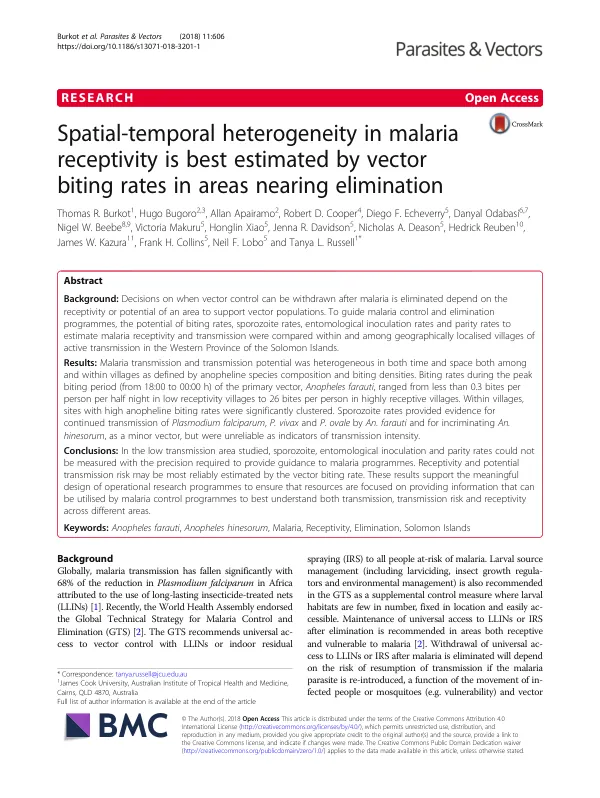
This heterogeneity is evident in both time and space, among and within villages, as defined by anopheline species composition and biting densities. The primary vector, Anopheles farauti, exhibits a biting profile that has shifted from all-night biting with both indoor and outdoor biting to predominantly biting early in the evening and outdoors. This behavioral change enables the mosquito to minimize contact with World Health Organization-recommended interventions, such as long-lasting insecticide-treated nets (LLINs) and indoor residual spraying (IRS), which are applied inside houses. Biting rates during the peak biting period of Anopheles farauti ranged from less than 0.3 bites per person per half night in low-receptivity villages to 26 bites per person in highly receptive villages. Within villages, sites with high anopheline biting rates were significantly clustered. Sporozoite rates provided evidence for continued transmission of Plasmodium falciparum, P. vivax, and P. ovale by Anopheles farauti and for incriminating Anopheles hinesorum, a minor vector, but were unreliable as indicators of transmission intensity. The study was conducted in 11 coastal villages located on the volcanic, mountainous, rain-forested islands of Ghizo, Kohinggo, Kolombangara, New Georgia, and Ranonnga Islands of Western Province of the Solomon Islands. Prior to commencing the entomological survey, the malaria prevalence across the study villages in Western Province was estimated to be 2.1% (measured by PCR in 2013). The area is classified by the Solomon Islands Government as a "near elimination" province. In contrast, Central Province had a malaria prevalence of 13.4% (as measured by PCR in 2012). The climate of the region is hot and wet, with an annual rainfall of 3725 mm (mean from 1999 to 2010). Sixty-eight percent of study village residents self-reported sleeping under a long-lasting insecticide-treated net. Anopheline biting densities were estimated in the Western Province between March 2014 and August 2016 for 4 nights per village survey (n = 2064 man-nights), and in Haleta (Central Province) between August 2011 and August 2016 for 5 nights per survey (n = 1534 man-nights). The study aimed to compare the utility of different entomological indicators to estimate malaria receptivity, transmission, and transmission potential across time and space. The comparison was made across 11 villages that spanned a malaria foci in the Western Province of the Solomon Islands. The results suggest that receptivity and potential transmission risk may be most reliably estimated by the vector biting rate. These findings support the meaningful design of operational research programs to ensure that resources are focused on providing information that can be utilized by malaria control programs to best understand both transmission, transmission risk, and receptivity across different areas. The study highlights the importance of understanding how to quantify receptivity to guide malaria elimination programs. The results of this study have implications for the design of operational research programs and the development of strategies for maintaining malaria elimination in areas with low transmission. The findings also emphasize the need for continued entomological monitoring and surveillance to inform malaria control and elimination efforts in the Solomon Islands.