WORLD HEALTH ORGANIZATION
Spotlight on Neonatal Resuscitation for Birth Asphyxia
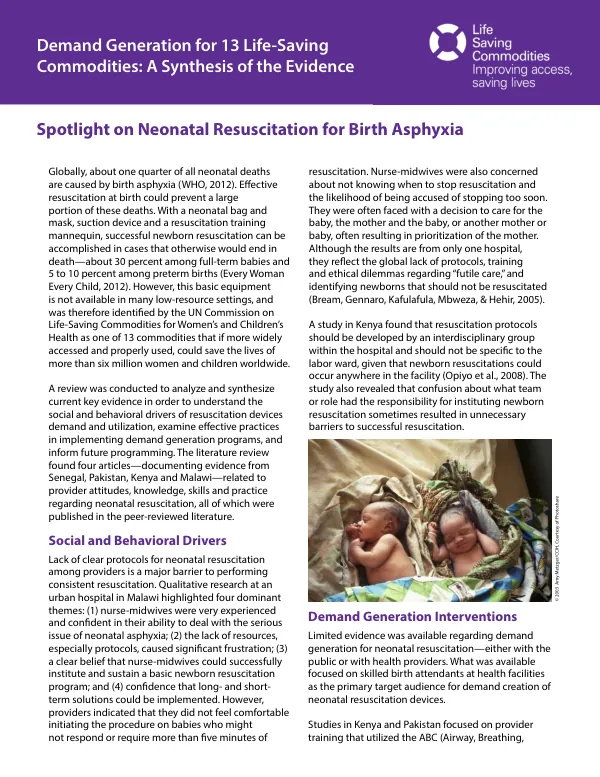
Neonatal Resuscitation for Birth Asphyxia is a critical issue globally, with approximately one quarter of all neonatal deaths caused by birth asphyxia.
2012 · 2 pages
Sign in to readA free account is required to download.
Abstract
Effective resuscitation at birth could prevent a large portion of these deaths, with successful newborn resuscitation achievable in cases that otherwise would end in death, about 30 percent among full-term babies and 5 to 10 percent among preterm births. However, basic equipment such as a neonatal bag and mask, suction device, and resuscitation training mannequin is not available in many low-resource settings. The UN Commission on Life-Saving Commodities for Women's and Children's Health identified this equipment as one of 13 commodities that if more widely accessed and properly used, could save the lives of more than six million women and children worldwide. A review was conducted to analyze and synthesize current key evidence in order to understand the social and behavioral drivers of resuscitation devices demand and utilization, examine effective practices in implementing demand generation programs, and inform future programming. The literature review found four articles documenting evidence from Senegal, Pakistan, Kenya, and Malawi related to provider attitudes, knowledge, skills, and practice regarding neonatal resuscitation. Lack of clear protocols for neonatal resuscitation among providers is a major barrier to performing consistent resuscitation. Qualitative research at an urban hospital in Malawi highlighted four dominant themes: nurse-midwives were very experienced and confident in their ability to deal with the serious issue of neonatal asphyxia; the lack of resources, especially protocols, caused significant frustration; a clear belief that nurse-midwives could successfully institute and sustain a basic newborn resuscitation program; and confidence that long- and short-term solutions could be implemented. However, providers indicated that they did not feel comfortable initiating the procedure on babies who might not respond or require more than five minutes of resuscitation. Demand generation for neonatal resuscitation is a critical issue, with limited evidence available regarding demand generation for neonatal resuscitation either with the public or with health providers. Studies in Kenya and Pakistan focused on provider training that utilized the ABC (Airway, Breathing, Circulation) approach to resuscitation. In Kenya, trained providers demonstrated a higher proportion of adequate initial resuscitation steps compared to the control group. In Pakistan, 90 percent of respondents who had been trained reported the use of acquired skills and the structured ABC approach in handling emergencies. Participants in both studies also noted barriers to neonatal resuscitation including the need for policy, ongoing training, lack of equipment, and lack of support from higher levels. Recommendations to overcome barriers to neonatal resuscitation include adopting a standard multidisciplinary approach to newborn resuscitation, which includes continual re-certification of providers; increasing knowledge of technical specifications at various levels; and developing local protocols and guidelines. These recommendations aim to improve the uptake of use of neonatal resuscitation equipment and reduce the number of neonatal deaths caused by birth asphyxia.
Related documents