USAID DEC
Spring X Winter - Oregon State University
Evaluates project to improve winter wheat for LDC"s by hybridizing spring and winter wheat.
Jackson, Robert I.; Yohe, John M. · 1982
Sign in to readA free account is required to download.
Abstract
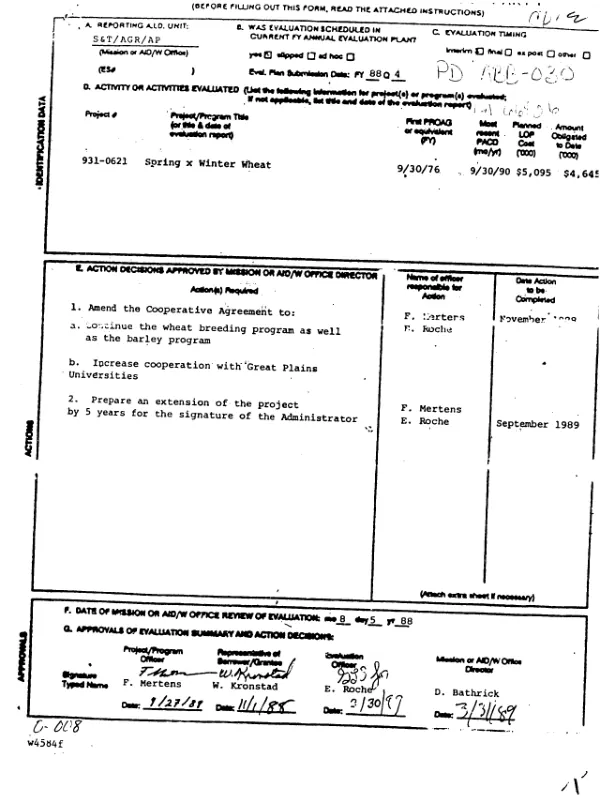
Evaluation covers the period 7/80-4/82 and consists of a PES based on an attached special evaluation (XD-AAL-460-A). The project is proceeding well, with results exceeding expectations. Oregon State University (OSU) has provided international winter/spring wheat screening nurseries, each containing 250 entries, to 98 cooperators in 48 LDC"s; 84% either responded to solicitations for data or explained why no data were available, thus illustrating the high degree of interest in the project. In OSU"s training program, which has more applicants than can be funded, graduate students are well prepared academically and benefit from network linkages with other wheat programs. Combined with continued contact by OSU with trainees upon their return home, the program ensures continued quality input into wheat research worldwide. OSU has worked cooperatively with the International Maize and Wheat Improvement Center (CIMMYT), which depends on OSU for the winter wheat parents for the initial crosses of its successful spring wheat program. At the goal level, the project has made notable progress in identifying varieties and lines with greater yield potential, especially for marginal growing areas. The evaluation team was asked to judge whether the project, despite its success and importance, should continue to be funded in light of dwindling A.I.D. budgetary resources and the existence of other projects of this type. The team agreed that CIMMYT"s assumption of project management and funding, a possibility they were asked to consider, is neither likely nor feasible, and recommended that the project be extended, on a 5-year rather than a 3-year basis, to allow OSU to plan the graduate training component and to attract a high quality staff. Action decisions are to: eliminate research on improving the nutritional quality of winter wheat; establish linkages with the U.S. Department of Agriculture; keep missions informed of nursery sites and of LDC cooperators in their countries; stimulate public awareness of the project; and contact returned trainees annually.
Related documents