JHPIEGO
SSQH National Training Centers
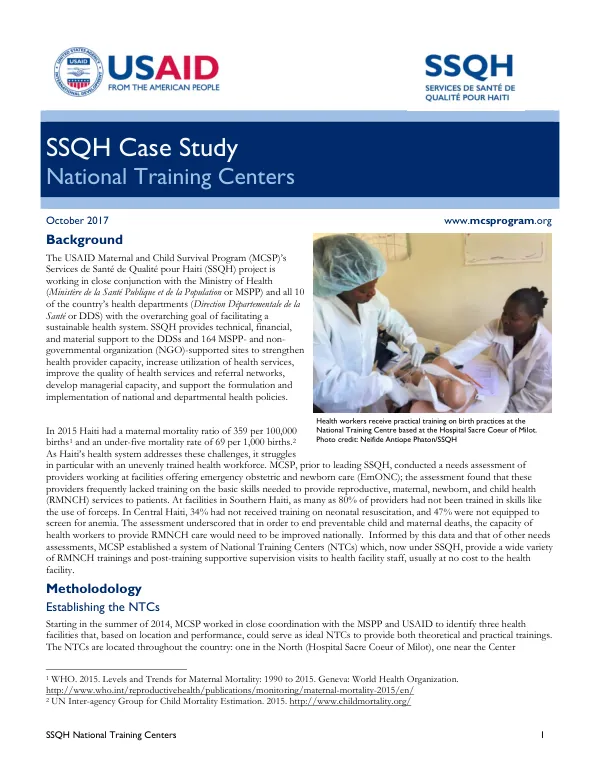
The National Training Centers (NTCs) in Haiti were established to provide a wide range of reproductive, maternal, newborn, and child health (RMNCH) trainings to health providers.
2017 · 3 pages
Sign in to readA free account is required to download.
Abstract
The NTCs are located throughout the country, with one in the South, one in the Center, and one in the North. The NTCs are staffed by a training coordinator, trainers, and a financial team, and are supported by SSQH staff and consultants who provide trainings-of-trainers and supportive supervision visits. The NTCs offer trainings on various RMNCH topics, including biosecurity, contraceptive technologies, day of birth best practices, essential care for every baby, outpatient care, and post-partum intrauterine devices. The trainings are conducted by a team of six to nine trainers who work as hospital staff and deliver the trainings on a rotating schedule. The NTCs also conduct follow-up supportive supervision visits to reinforce the trainings and identify barriers to implementation. Between October 2016 and September 2017, the NTCs conducted 53 trainings, reaching 514 health providers, and conducted follow-up supportive supervision visits at 48 sites. The trainings focused on various RMNCH topics, including the Day of Birth Package, which includes modules on Helping Babies Breathe, Essential Care for Every Baby, and Helping Mothers Survive. Despite the success of the NTC model, the system has faced challenges, including a non-specialized workforce, workforce turnover, and a lack of equipment and supplies in facilities. The NTCs are becoming sustainable and are expected to continue operations after the close of SSQH. The NTCs are also working to ensure that the skills of Haiti's health workforce are consistently reinforced. The NTCs have provided trainings on various RMNCH topics, including: * Biosecurity * Contraceptive technologies * Day of birth best practices * Essential care for every baby * Outpatient care and antenatal and postnatal care * Helping babies breathe * Helping mothers survive * Post-partum intrauterine devices * Long active reversible contraceptives (LARCs) * Kangaroo mother care (KMC) The NTCs have also conducted follow-up supportive supervision visits at various sites, including: * Milot: 148 unique participants, 18 trainings, and 18 supportive supervision visits * Mirebalais: 250 unique participants, 22 trainings, and 20 supportive supervision visits * Saint Boniface: 116 unique participants, 13 trainings, and 12 supportive supervision visits The NTCs have also worked to ensure that coordination between the NTCs and the government is well-maintained, and have lobbied successfully for the integration of NTC activities into MSPP work plans.