INTRAHEALTH
Strengthening Human Resources Management and Leadership
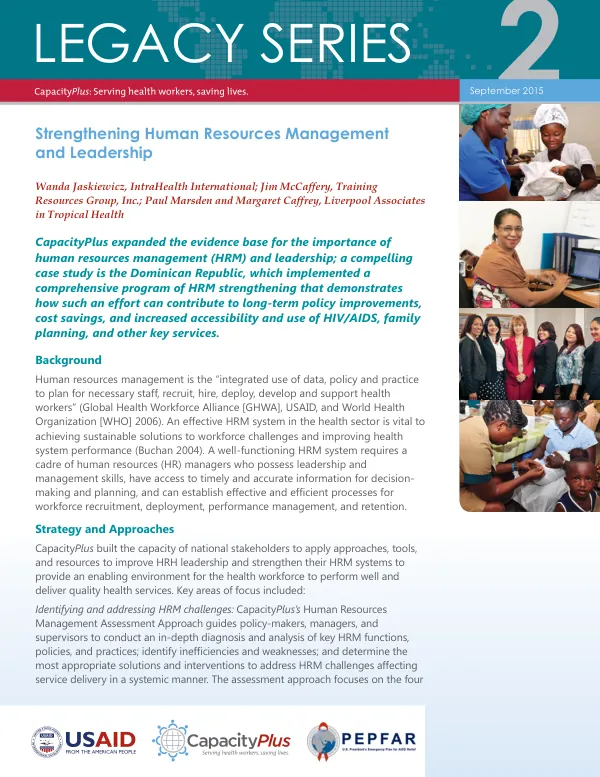
Human resources management (HRM) is the integrated use of data, policy, and practice to plan for necessary staff, recruit, hire, deploy, develop, and support health workers.
2015 · 6 pages
Sign in to readA free account is required to download.
Abstract
An effective HRM system in the health sector is vital to achieving sustainable solutions to workforce challenges and improving health system performance. A well-functioning HRM system requires a cadre of human resources managers who possess leadership and management skills, have access to timely and accurate information for decision-making and planning, and can establish effective and efficient processes for workforce recruitment, deployment, performance management, and retention. CapacityPlus expanded the evidence base for the importance of HRM and leadership by supporting the implementation of a comprehensive program of HRM strengthening in the Dominican Republic. The program demonstrated how such an effort can contribute to long-term policy improvements, cost savings, and increased accessibility and use of HIV/AIDS, family planning, and other key services. The Ministry of Health (MOH) in the Dominican Republic drew on the HRM Assessment Approach to conduct a situation analysis of the health workforce in the country's nine regions. The results guided the MOH to develop a national HRH strategic plan and design interventions to strengthen HRM systems at the national, regional, and facility levels. The HRM Assessment Approach focuses on four main functional areas that are key for an effective HRM system: health workforce planning and implementation, work environment and conditions, HR information systems, and performance management. CapacityPlus also built the capacity of HR leaders through its comprehensive Human Resources for Health (HRH) Professional Development Program, which contains training session plans and materials that have been used to develop the knowledge and skills of HR leaders, managers, and others responsible for the planning and management of the health workforce. The program in the Dominican Republic led to significant improvements in the delivery of prevention of mother-to-child transmission (PMTCT) of HIV and other key services. The MOH eliminated 3,913 ghost workers for an annual savings of $9.1 million, which was invested in purchasing medicines and supplies, repairing health facilities, and increasing access to health services at the primary level through hiring 2,511 doctors, nurses, and area coordinators. The program also contributed to a shift in the role of HR managers from a purely administrative function to a more strategic role in improving the health workforce and quality of care through HR-related interventions. In Ghana, CapacityPlus supported the re-energization and revitalization of the Ghana Health Workforce Observatory, a multisector, multiorganization HRH stakeholder leadership group. The efforts contributed to the Observatory-led development of a national health workforce information system, which improved the availability and use of health workforce data in Ghana. The program also enhanced the capacity of HR managers in Ghana to improve the quality of care through HR-related interventions, such as recruitment, deployment, and performance management.