ABT ASSOCIATES
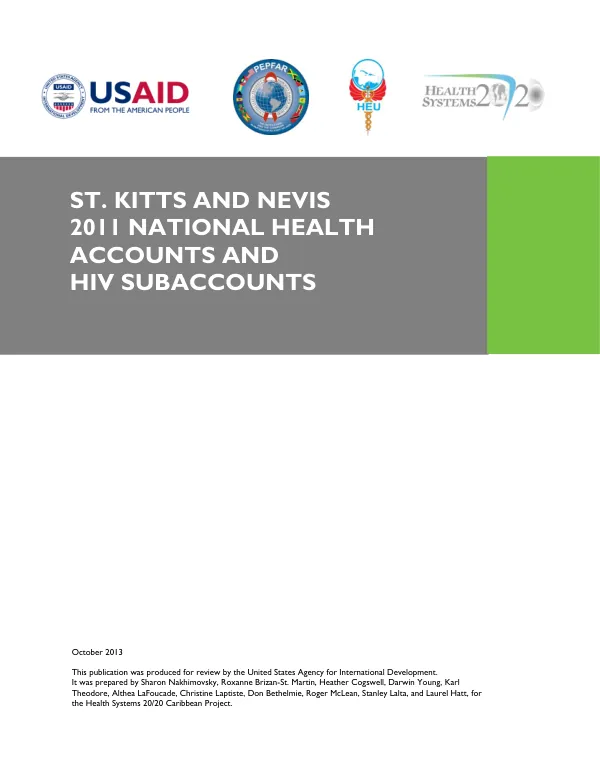
St. Kitts and Nevis 2011 National Health Accounts and HIV Subaccounts
The Health Systems 20/20 Caribbean project is a technical assistance program within the U.S.-Caribbean Regional PEPFAR Partnership Framework.
2013 · 95 pages
Sign in to readA free account is required to download.
Abstract
Its purpose is to support governments in strengthening their health financing systems for a sustainable HIV/AIDS response in the Caribbean. The project is implemented by Abt Associates Inc. and funded by the United States Agency for International Development (USAID) under the Cooperative Agreement # AID-538-LA-12-00001. The project's focus is on St. Kitts and Nevis, where the 2011 National Health Accounts (NHA) and HIV Subaccounts were conducted. The NHA provides a comprehensive overview of the country's health financing system, including the sources of funding, the entities that manage health funds, and the types of goods and services purchased with health funds. The HIV Subaccounts provide a detailed analysis of the financing of HIV care in the country. The NHA findings indicate that the majority of health funding in St. Kitts and Nevis comes from government sources, with a significant portion also coming from private insurance and out-of-pocket (OOP) spending. The Ministry of Health (MOH) is the primary manager of health funds, with a significant portion of funds allocated to healthcare providers, including public and private hospitals, clinics, and pharmacies. The HIV Subaccounts findings indicate that the majority of HIV funding in St. Kitts and Nevis comes from government sources, with a significant portion also coming from international donors and OOP spending. The MOH is the primary manager of HIV funds, with a significant portion of funds allocated to healthcare providers, including public and private hospitals, clinics, and pharmacies. The study also found that there are significant disparities in health spending between different socioeconomic groups, with households with higher incomes spending more on healthcare. The study recommends that the government of St. Kitts and Nevis should prioritize increasing funding for healthcare, particularly for vulnerable populations, and improving the efficiency of the healthcare system. The study also highlights the importance of strengthening the health financing system in St. Kitts and Nevis, including improving the management of health funds, increasing transparency and accountability, and improving the efficiency of the healthcare system. The study recommends that the government of St. Kitts and Nevis should work with international partners to strengthen the health financing system and improve access to healthcare for all citizens. The study's findings and recommendations are based on a comprehensive analysis of the NHA and HIV Subaccounts data, as well as a review of existing literature and stakeholder engagement. The study provides a valuable contribution to the understanding of the health financing system in St. Kitts and Nevis and highlights the need for continued investment in healthcare to improve the health outcomes of the population. The study's methodology involved a comprehensive review of existing literature and stakeholder engagement, as well as a detailed analysis of the NHA and HIV Subaccounts data. The study used a combination of quantitative and qualitative methods to analyze the data, including regression analysis and thematic analysis. The study's results are presented in a series of tables and figures, which provide a detailed overview of the health financing system in St. Kitts and Nevis. The study's findings are also presented in a series of policy implications and recommendations, which highlight the need for continued investment in healthcare to improve the health outcomes of the population.