USAID
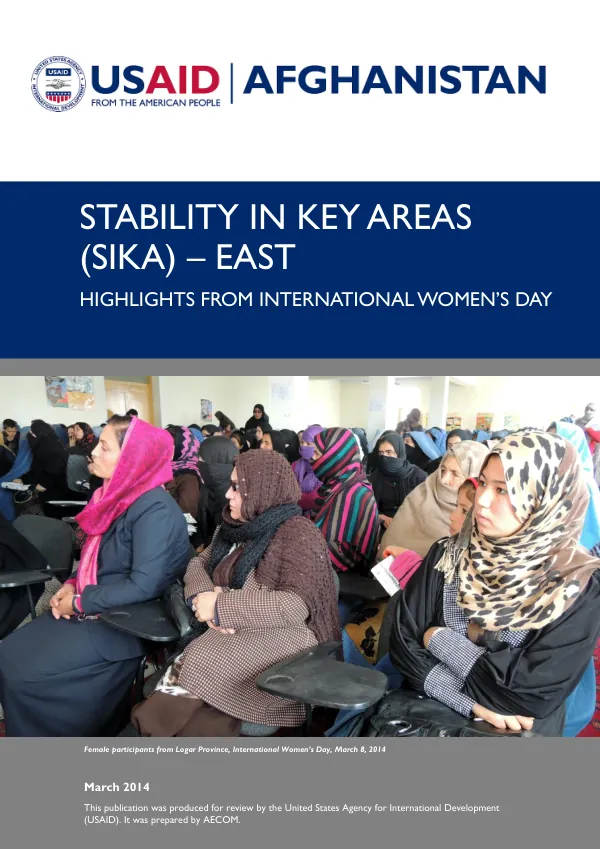
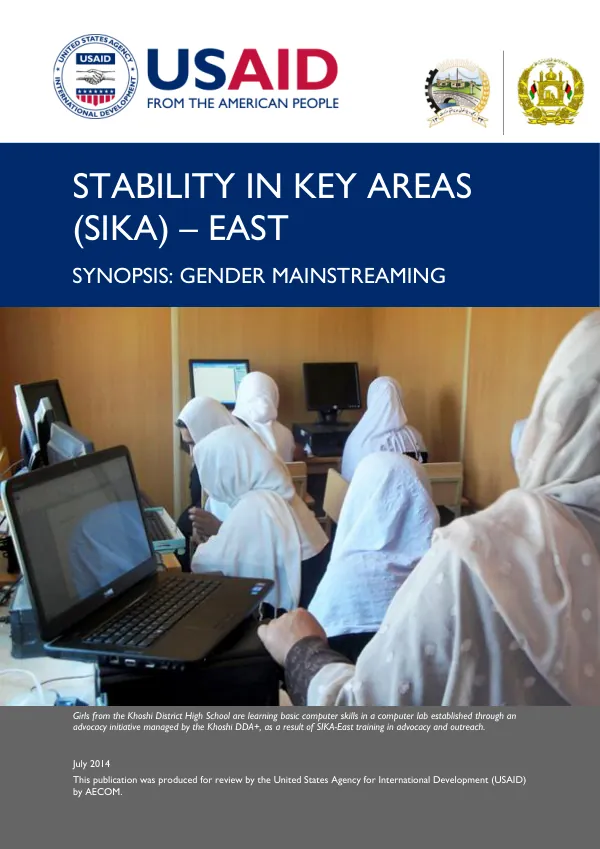
Stability in Key Areas (SIKA)-East Synopsis: Gender Mainstreaming
Gender norms, attitudes, and behaviors vary significantly across the six provinces in which Stability in Key Areas (SIKA)-East works.
2014 · 11 pages
Sign in to readA free account is required to download.
Abstract
These factors are influenced by conflict, ethnicity, culture, rural/urban locale, age, economic status, and other dynamics. They also contribute to distinctions in how women and men exercise authority, communicate and interact, perceive problems, pursue solutions, access opportunities, and confront barriers. Recognizing gender dimensions and applying a gender-responsive approach are fundamental aspects of leadership, good governance, and accountability; these go hand-in-hand with efforts to reduce gender disparities and discrimination. Therefore, SIKA-East places gender equity, female leadership, and inclusion at the heart of program management and implementation. Mainstreaming gender is not only about adding a female component into an existing process or activity, and it goes beyond increasing women's participation. Rather, mainstreaming gender means bringing the experience, knowledge, and interests of women and men to influence programmatic objectives and anticipated results. Effectively, gender must be a lens through which programming is considered – from design to implementation to evaluation. Given SIKA-East's objectives, it is critical that governance and decision-making processes be truly representative of both men and women. This will enable all to contribute to the advancement of Afghanistan. The SIKA-East Gender Mainstreaming Strategy provides the framework to operationalize these aims, guiding staff and partners to develop awareness and competency to equitably enable women and men to become informed citizens, voice interests, concerns, and needs, access and control resources, and influence and benefit from public services. SIKA-East assists partners to apply gender-sensitive perspectives to planning, design, implementation, and evaluation of program activities. This includes supporting the comprehensive involvement of women in governance and development processes that contribute to advancing Government of the Islamic Republic of Afghanistan (GIRoA) policies and practice and facilitating equitable participation and access for men and women, with appreciation of the different roles and contributions of each. SIKA-East will integrate and complement key gender policies and priorities of GIRoA, particularly the Independent Directorate of Local Governance (IDLG) and the Ministry of Rural Rehabilitation and Development (MRRD). Core commitments to gender in the Sub-National Governance Policy developed by IDLG are at the heart of SIKA-East's mainstreaming approach. To achieve this, IDLG outlines the following points to be undertaken with the support of the Provincial Governor: both genders are an active part of all discussions, initiatives, and consensus building; special efforts are needed to bridge the gaps seen historically between the two genders; an enabling environment needs to be created, where both men and women can have their strategic needs met; and both men and women make valuable human resources for the Province. MRRD's Gender Policy also provides a critical foundation for SIKA-East's gender mainstreaming efforts. Like MRRD, SIKA-East believes that gender equality is essential for growth and poverty reduction. Failure to decrease disparities hampers the successful attainment of development goals, such as reducing child mortality, improving safe motherhood, and decreasing malnutrition rates. The achievement of economic development will not be possible without the inclusion of women's priorities, development of their leadership, and full participation in society and government. SIKA-East will work closely with MRRD programs, such as the National Area Based Development Program (NABDP), to exchange lessons and best practices and to share accomplishments to improve coordination to reach maximum impact. During its work in the provinces and districts covered by the program, SIKA-East will explore the five dimensions of gender, including voice, representation, and leadership; influence and decision-making; participation; access to information; and benefit from services. SIKA-East will also work with the District Development Assemblies-Plus (DDA+) to develop and apply skills to carry out responsibilities related to gender mainstreaming, such as ensuring that gender issues are fully reflected in development planning, monitoring and evaluation, resolving public complaints, and oversight and public outreach.