DAI
USAID Promote Musharikat Quarterly Report FY 2018 Q3 (April-June 2018)
The USAID Promote Musharikat Project is a quarterly report for FY 2018 Q3, covering the period from April to June 2018.
2018 · 26 pages
Sign in to readA free account is required to download.
Abstract
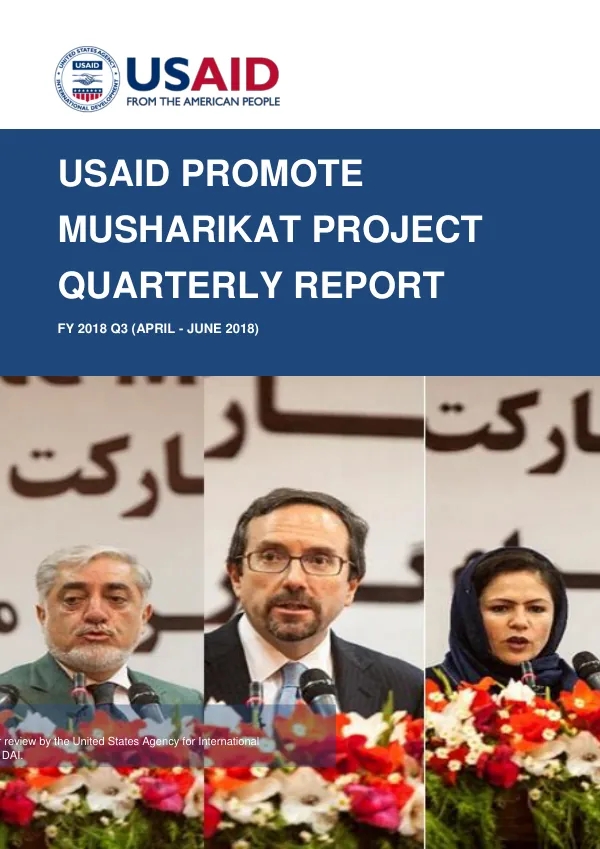
The project aims to promote women's equality and empowerment in Afghanistan through various activities and coalitions. The project has made significant progress in building constituencies among national, provincial, and local activists and groups focused on promoting women's equality and empowerment. Eight issue-based coalitions have been formed, with participation from at least 300 women's rights-focused civil society organizations (CSOs) and 5,000 activists from all 34 provinces. The coalitions have been working on various priority issues, including Access to Justice, Women's Political Participation, Access to Healthcare, Access to Education, Access to Economic Opportunities, and Violence Against Women. One of the notable achievements of the project is the growth of the Women's Leadership Development (WLD) Jawana graduates in Musharikat coalitions. More than 150 WLD Jawana graduates were enrolled in Musharikat coalitions in May alone, bringing the total number to 224. The project continues to register new members, with 207 CSOs and 1,897 activists registered as coalition members to date. The project has also made progress in strengthening more effective issue-based advocacy for women's equality and empowerment. The coalitions have been working on challenging research, such as the Violence Against Women Coalition's survey on the status of legal cases under the Ending Violence Against Women Law. The Access to Education Coalition has held multiple meetings and participated in technical working group sessions with leaders from the Ministry of Education and the Independent Administrative Reform and Civil Service Commission to address the opportunity of increasing the number of women teachers. The project has also increased awareness and support for women's rights in all 34 provinces of Afghanistan. The Musharikat National Summit was a highlight of the quarter, with the engagement of His Excellency Chief Executive Dr. Abdullah Abdullah and the US Ambassador to Afghanistan Mr. John Bass demonstrating to the coalition members the importance of their work and providing meaningful encouragement for their future endeavors. The project has also made progress in civil society and GIRoA (Government of the Islamic Republic of Afghanistan) being more effective partners in strengthening the development and implementation of gender policies. The project continues to work with government stakeholders and civil society organizations to address the challenges faced by women in Afghanistan. The project has also made progress in promoting women's leadership development, with the WLD Jawana graduates playing a key role in the coalitions. The project has also made progress in promoting women's political participation, with the Women's Political Participation (WPP) Coalition's Voter Registration Campaign being a notable example of fulfilling the directive from the US Ambassador to Afghanistan to "change the daily experiences of women." Overall, the project has made significant progress in promoting women's equality and empowerment in Afghanistan, and it continues to work towards its goals of building constituencies, strengthening issue-based advocacy, increasing awareness and support, and promoting women's leadership development and political participation.
Related documents