USAID DEC
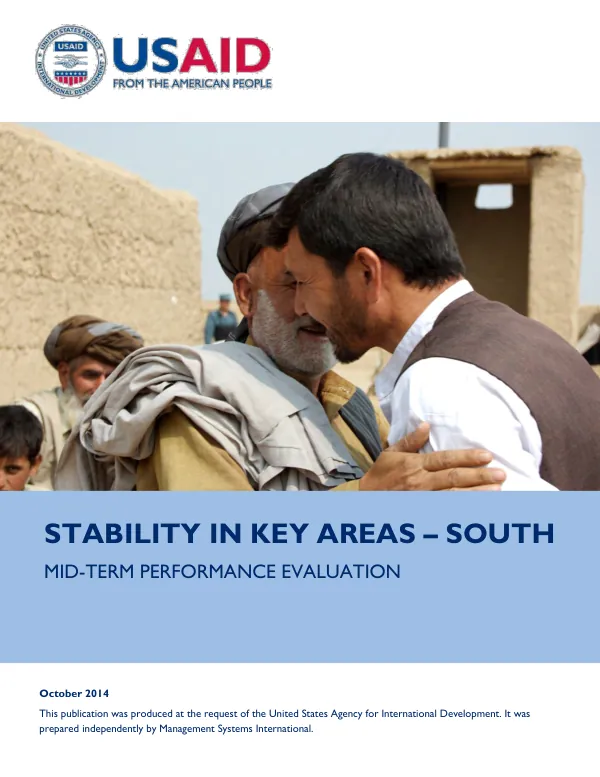
Stability in Key Areas (SIKA) South – Contract AID-306-C-13-00003 Quarterly Report for January 1 – March 31, 2013
Sign inAFGHAN MINISTRY OF RURAL REHABILITATION AND DEVELOPMENT
Stability in Key Areas (SIKA) South – Contract AID-306-C-13-00003 Quarterly Report for January 1 – March 31, 2013
The Stability in Key Areas (SIKA) South program is designed to promote stabilization in key areas by supporting the Government of the Islamic Republic of Afghanistan (GIRoA) at the district level, while coordinating efforts at the provincial level.
2013 · 19 pages
Sign in to readA free account is required to download.
Abstract
The program aims to implement community-led development and governance initiatives that respond to the population's needs and concerns, building confidence, stability, and increasing the provision of basic services. The program's strategic objective is to increase Afghans' confidence in their district-level government, leading to the expansion of GIRoA provincial authority and legitimacy. The program objective is to assist GIRoA officials at the district and provincial levels to respond to the population's needs and concerns. Progress toward the indicators and intermediate results in the Performance Monitoring Plan is discussed in the Quarterly Report. The report outlines how the contract objectives have been achieved this quarter, including progress made during the previous quarter, problems encountered, successes, and good practices for programming in less-permissive areas. The SIKA South Program has been operating since April 10, 2013, under a separate USAID contract with AECOM (AID-306-C-12-00005). A summary of progress under the initial contract is included at Annex A. The program is designed to support the GIRoA at the district level, while coordinating efforts at the provincial level, to implement community-led development and governance initiatives. The program's key interventions include supporting the GIRoA in implementing community-led development and governance initiatives, building the capacity of district entities to respond to the population's needs and concerns, and improving the delivery of basic services. The program also focuses on building the capacity of provincial authorities to communicate with district entities and prioritize basic service delivery interventions. Progress in achieving the intermediate results is reported in the Quarterly Report. Intermediate Result 1 (IR1) focuses on provincial and district entities addressing sources of instability and responding to the population's development and governance concerns. IR2 focuses on provincial and district entities understanding organizations and provincial line departments working within their geographic areas, the services they provide, and how the population can access those services. IR3 focuses on provincial authorities improving their ability to communicate with district entities to help them better understand their population's needs and prioritize basic service delivery interventions. IR4 focuses on provincial authorities improving basic service delivery by using GIRoA, CDCs, DDAs, and ASOP DCCs, which gain capacity to plan, design, implement, and monitor projects, with a focus on labor-intensive projects or productive infrastructure. The program has made progress in achieving the intermediate results, with provincial and district entities increasingly addressing sources of instability and responding to the population's development and governance concerns. The program has also improved the delivery of basic services, with a focus on labor-intensive projects or productive infrastructure. The Quarterly Report also includes a summary of results on the SIKA South Contract AID-306-C-12-00005 as of March 31, 2013, which is included at Annex C. The report provides an overview of the program's progress, challenges, and successes, and outlines the program's plans and strategies for the next quarter.