AFGHAN MINISTRY OF RURAL REHABILITATION AND DEVELOPMENT
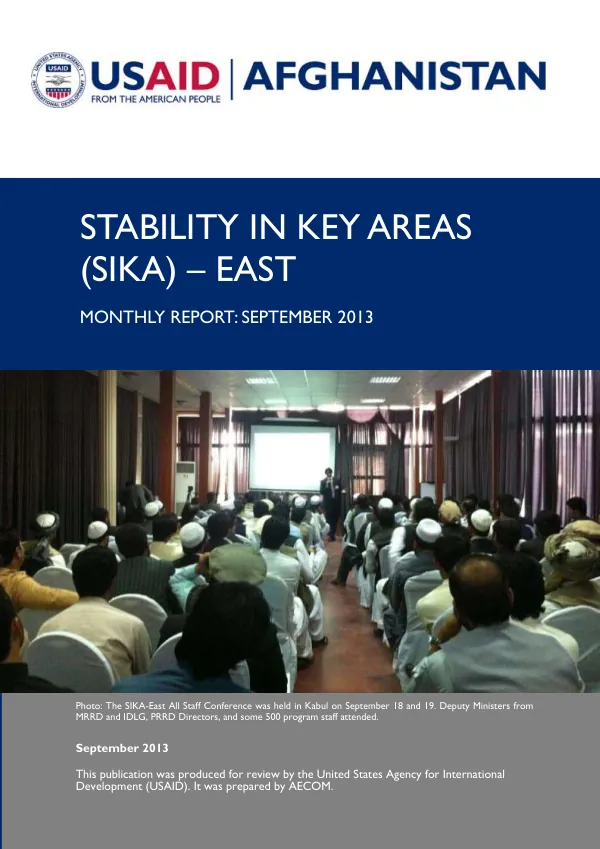
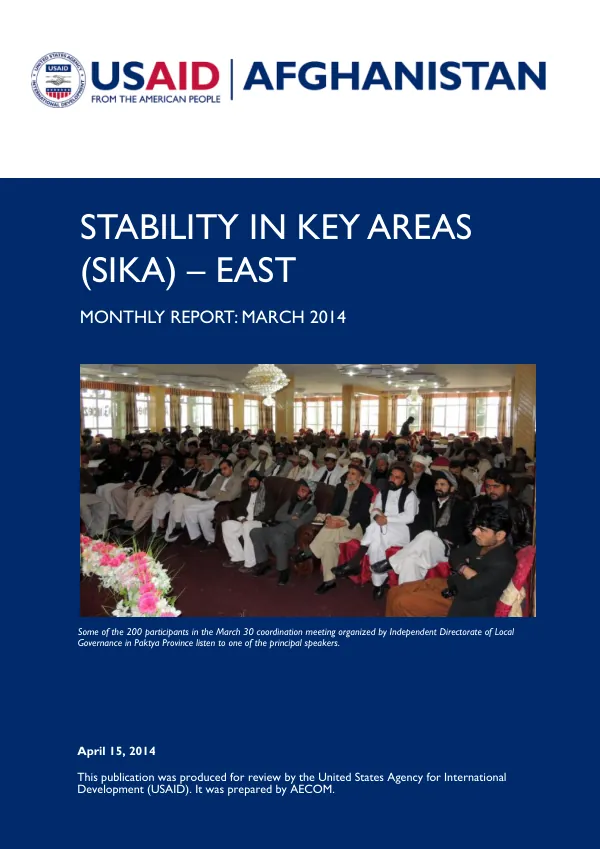
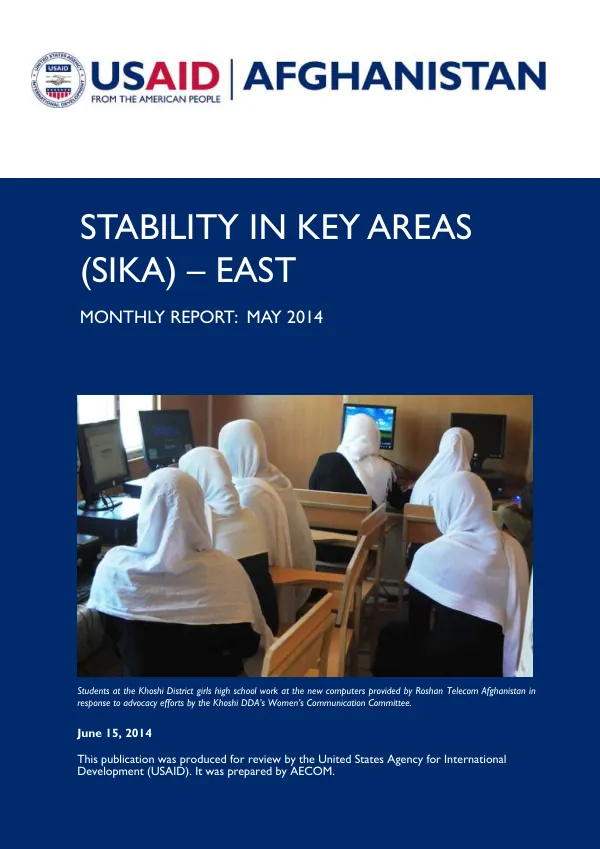
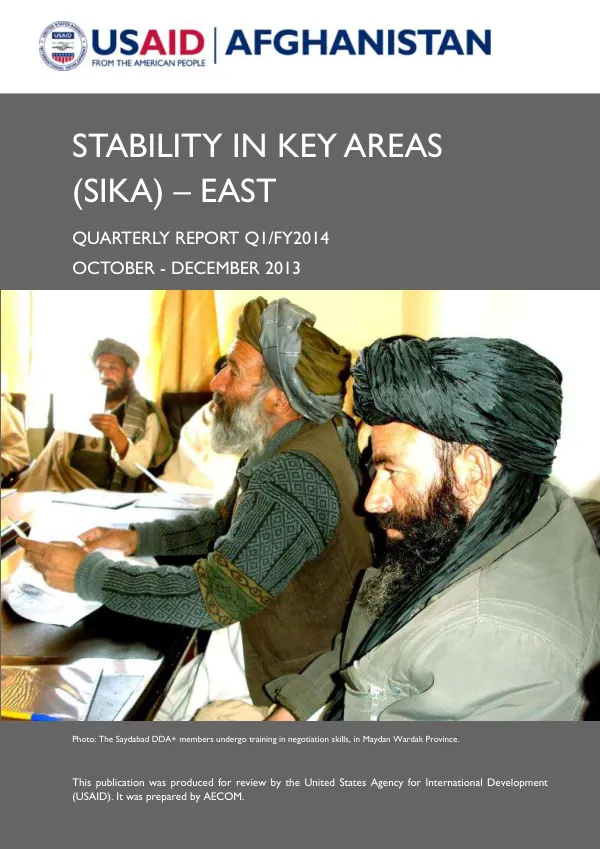
Stability in Key Areas (SIKA) - East Quarterly Report Q1FY2014
Stability in Key Areas (SIKA) - East is a program aimed at strengthening governance and service delivery to improve stability in conflict-affected districts of southeastern Afghanistan.
2014 · 59 pages
Sign in to readA free account is required to download.
Abstract
The program is a collaborative effort between SIKA-East, the Afghan Ministry of Rural Rehabilitation and Development (MRRD), and the Independent Directorate of Local Governance (IDLG). The program's life span is from December 2011 to September 2015, and it operates in all 21 planned districts in five provinces: Ghazni, Khost, Logar, Maydan Wardak, and Paktya. The program's primary focus is on building the capacity of District Development Assemblies Plus (DDAs+) to plan and implement projects that address the needs of their communities. As of December 31, 2013, the program had achieved several milestones, including the completion of the Stability Planning Process capacity building with 1,715 persons from all DDAs+, the creation of 22 District Project Portfolios, and the training of 19,573 individuals in stability, resource mobilization, and outreach. The program has also made significant progress in infrastructure development, with 47 infrastructure grant projects completed, injecting a value of $1,933,752 into local communities and creating employment for 2,298 individuals over 73,080 workdays. Additionally, 100 stability grants valued at $4,437,691 were awarded to district entities, benefiting an estimated total of 140,563 individuals. The program has also established a strong network of service providers, with nine Service Providers (SP) Fairs conducted in all five provinces, attended by 551 SPs and 10,535 visitors. Five SP Catalogues have been completed and regularly updated, made available to 182 organizations and 1,808 individuals. Furthermore, 19 DDA+ Communication Committees have been formed and 11 communication plans completed. The program's achievements have been recognized through a series of high-level conferences held in Kabul and provincial capitals, linking national and subnational government to representatives of their constituents. The program's success has also been marked by the launch of new capacity enhancement initiatives in support of the transition to the Afghan government. The program's geographic focus is on the five provinces of Ghazni, Khost, Logar, Maydan Wardak, and Paktya, where it is working to improve stability and governance in conflict-affected districts. The program's timeframes are from December 2011 to September 2015, with a focus on achieving its objectives within this period. The program's methodology involves building the capacity of DDAs+ to plan and implement projects that address the needs of their communities. This is achieved through a range of activities, including training, infrastructure development, and grants. The program also works closely with local government and other stakeholders to ensure that its activities are aligned with national and subnational priorities. The program's key findings and conclusions highlight the importance of building the capacity of local institutions to deliver services and improve stability in conflict-affected areas. The program's achievements demonstrate the potential for collaborative efforts between government, civil society, and the private sector to improve governance and service delivery in Afghanistan. The program's implementation details are outlined in the program's work plan, which outlines the specific activities and milestones that the program aims to achieve. The program's work plan is aligned with the program's overall objectives and is designed to ensure that the program's activities are focused and effective. The program's recommendations highlight the need for continued support for local institutions and the importance of building their capacity to deliver services and improve stability in conflict-affected areas. The program's recommendations also emphasize the need for continued collaboration between government, civil society, and the private sector to achieve the program's objectives.