AFGHAN MINISTRY OF RURAL REHABILITATION AND DEVELOPMENT
Stability In Key Areas (SIKA) – West / Monthly Report – January 2014
The Stability in Key Areas (SIKA) – West program is a USAID-funded initiative aimed at increasing stability and paving the way for transition in the western provinces of Afghanistan, specifically Herat, Farah, Badghis, and Ghor.
2014 · 34 pages
Sign in to readA free account is required to download.
Abstract
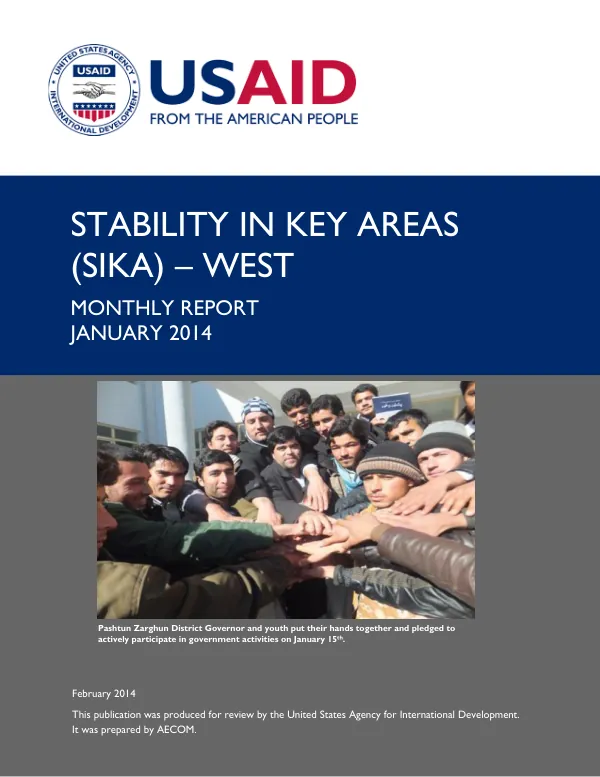
The program is administered through the Ministry of Rural Rehabilitation and Development (MRRD) in cooperation with the Independent Directorate of Local Governance (IDLG) and AECOM International Development. The program's primary objective is to support Provincial and District Governments in their efforts to stabilize the region. During the month of January 2014, seven District Stabilization Committee (DSC) meetings were held in Farah, Badghis, Herat, and Ghor Provinces, reaching a total of 482 people, including line-department representatives, District Development Assembly members, religious and tribal leaders, and community observers. The DSC meetings provided an opportunity to prioritize previously proposed mitigation activities and discuss the impact of the first contract period project activities. Additionally, the Tribal Conflict Resolution Committees (TCRCs) received conflict resolution training to enable them to identify, prioritize, and resolve conflicts at the district level. The TCRCs resolved three conflicts in Pashtun Zarghun, Muqur, and Pusht-e Rod Districts during January. However, DSC meetings were not held in Bala Boluk and Khak-e-Safayd Districts due to security concerns, and the DSC meeting in Shahrak was canceled due to severe cold weather and heavy snow. The Shahrak TCRC traveled to Masjed Negar and Kharnak villages to mediate between conflicting parties in these villages. The program's activities are focused on four Intermediate Results (IRs) and the overarching capacity building and gender program components. The IRs include supporting Provincial and District Governments, increasing stability, and paving the way for transition in the western provinces. The capacity building and gender program components aim to enhance the capacity of local governments and communities to manage and resolve conflicts. The program's geographic focus is on the four provinces of Herat, Farah, Badghis, and Ghor, as well as 10 districts within these provinces. The program's relations with MRRD, IDLG, communities, and other stakeholders are crucial to its success. The program's progress is monitored and evaluated through various mechanisms, including the Stability Analysis Mechanism (SAM) and the Measuring Impacts of Stabilization Intervention (MISTI). The program's achievements during January 2014 include the organization of seven DSC meetings, the provision of conflict resolution training to TCRC members, and the resolution of three conflicts in Pashtun Zarghun, Muqur, and Pusht-e Rod Districts. The program's challenges include security concerns in some districts and the cancellation of the DSC meeting in Shahrak due to severe weather conditions.