AFGHAN MINISTRY OF RURAL REHABILITATION AND DEVELOPMENT
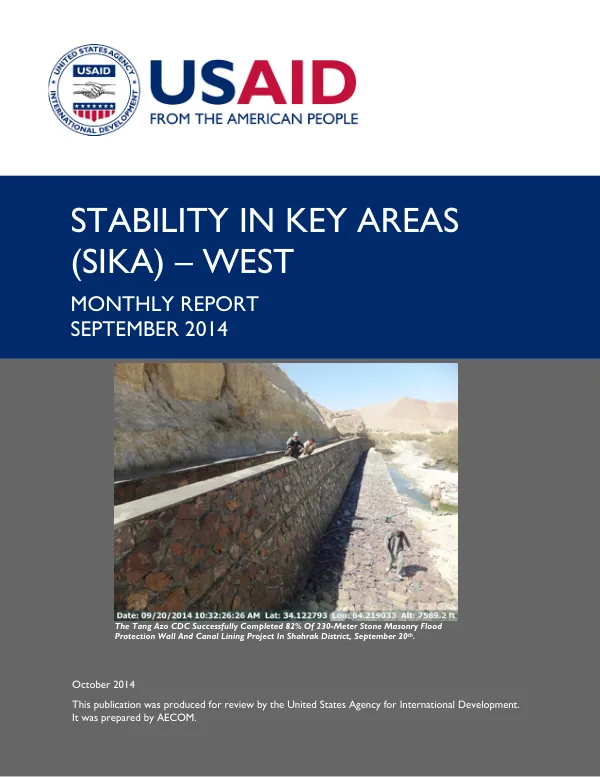
Stability In Key Areas (SIKA) – West / Monthly Report – September 2014
The Stability in Key Areas (SIKA) – West program is a USAID-funded initiative aimed at promoting stability in key areas of Afghanistan.
2014 · 22 pages
Sign in to readA free account is required to download.
Abstract
The program, led by the Ministry of Rural Rehabilitation and Development (MRRD) and the Independent Directorate of Local Governance (IDLG), began on January 29, 2012, and is scheduled to end on August 31, 2015. The program's primary objective is to assist provincial authorities and district-level government entities in improving governance programming and increasing the provision of priority basic services, ultimately increasing citizen confidence in and support for the Government of the Islamic Republic of Afghanistan (GIRoA). The SIKA-West program operates in four provinces: Farah, Badghis, Herat, and Ghor, incorporating 16 target districts. The program's area of operation includes Farah Province, with five districts: Farah Center, Bala Boluk, Pusht-e Rod, Khak-e-Safayd, and Lash Wa Juwayn; Herat Province, with five districts: Pashtun Zarghun, Shindand, Kushk Rabat-e Sangi, Guzara, and Kohsan; Badghis Province, with three districts: Qadis, Muqur, and Qala-i-Naw; and Ghor Province, with three districts: Chaghcharan, Shahrak, and Du Layna. During the month of September 2014, the SIKA-West program conducted 13 GIRoA-led Komite Sobate Woleswali (KSW) meetings. These meetings provided a forum for district residents and sub-national government entities to discuss current problems and grievances affecting residents within the districts and where government-led actions can address and mitigate these grievances. Participants at these KSW's included Provincial & District Governors & Line Department Managers, District Development Assemblies (DDA's), Community Development Councils (CDC's), and MRRD officials. The SIKA-West program also implemented various stabilization programming activities, including the establishment of a District Stability Matrix (DSM) to assess district stability and identify areas for improvement. The program also conducted a Stability Analysis Mechanism (SAM) to analyze district stability and identify potential areas of conflict. Additionally, the program provided training to district officials on conflict resolution and community development. The program's communications programming focused on improving communication between the government and the public, as well as between different government entities. The program conducted a series of public outreach activities, including radio broadcasts and community meetings, to inform the public about government programs and services. The SIKA-West program's community development programming aimed to improve the provision of basic services, such as healthcare, education, and infrastructure, in the target districts. The program worked with local communities to identify priority needs and develop plans to address these needs. The program also provided training to community development councils (CDCs) on community development and project management. The program's governance programming focused on improving the capacity of district and provincial government entities to deliver basic services and address community needs. The program provided training to government officials on governance, project management, and community development. The program also worked with local government entities to develop plans for improving governance and service delivery. The SIKA-West program's gender mainstreaming unit worked to ensure that the program's activities were inclusive of women and girls. The unit provided training to program staff on gender mainstreaming and worked with local communities to identify priority needs and develop plans to address these needs. The program's provincial and district overview provided a snapshot of the program's activities in each province and district. The overview highlighted the program's successes, challenges, and lessons learned in each area. The program's monitoring and evaluation activities aimed to assess the program's impact and identify areas for improvement. The SIKA-West program's lessons learned highlighted the importance of community engagement and participation in the program's activities. The program also emphasized the need for improved communication between the government and the public, as well as between different government entities. The program's challenges included limited resources and capacity constraints, which hindered the program's ability to implement its activities effectively.