USAID
Stability in Key Areas (SIKA) –West Weekly Report, January 28- February 03, 2014
The Stability in Key Areas (SIKA) –West initiative is a USAID-funded program aimed at promoting stability and development in the western provinces of Afghanistan.
2014 · 8 pages
Sign in to readA free account is required to download.
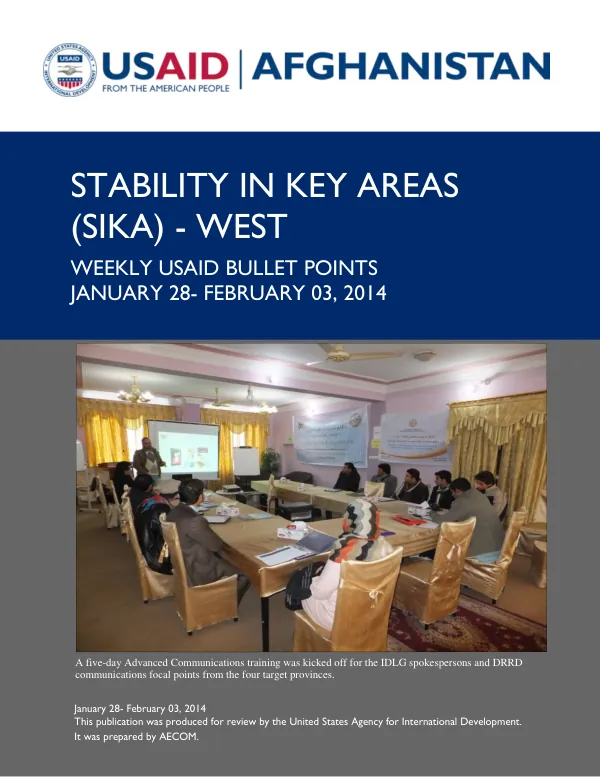
Abstract
The program focuses on building the capacity of local government officials, community development councils (CDCs), and other stakeholders to address key challenges and promote economic growth. Capacity building and coordination efforts were a key focus area for SIKA-West during the reporting period. A five-day Advanced Communications training was conducted for IDLG spokespersons and DRRD communications focal points from the four target provinces. The training aimed to strengthen communication and crisis management skills among the participants. Additionally, trainings on 'Site Visit Monitoring' were provided to 22 District Government staff, enabling them to monitor the work progress of projects implemented by CDCs. The Justice Training Transition Program (JTTP) collaborated with the International Development Law Organization (IDLO) to provide legal trainings for government staff. A list of qualified trainers was submitted to JTTP, enabling them to travel to districts and provide training. Furthermore, a coordination meeting was held between SIKA-West and the IDLG to strengthen coordination and broadcast SIKA-West success stories and achievements on the IDLG website. In terms of ongoing grants activities, 132 rehabilitation grant projects, including water dividers, bridges, culverts, flood protection walls, community center refurbishments, and road rehabilitations, were ongoing in the target provinces. Vocational grant trainings, including tailoring, embroidery, carpet weaving, welding, carpentry, and auto-mechanic courses, were also ongoing in Farah, Herat, Badghis, and Ghor Provinces. Local women in Mahal Koshak, Shindand District, were practicing tailoring skills, while Ulema in Shahrak met with the Acting District Governor to find a solution for the vacant position of a judge in the district. In Farah Province, Kochis nomads successfully advocated for their right to obtain National Identity Cards (Tazkara) after receiving advocacy trainings and organizing meetings with district and provincial authorities. The Pusht-e Rod farmers held a joint meeting with FAIDA, CCI, and the Economy Department to discuss the process of getting loans for farmers. Mr. Ghusuddin, the Pusht-e Rod District Governor, visited the work in-progress of the surrounding wall rehabilitation project in Massow village, while the Pusht-e Rod women DSC meeting was held with participation of eight influential women to discuss sources of instability and propose mitigation activities. In Badghis Province, a traffic policeman was hired to control the speed of ANA and ANP vehicles in residential areas, and expired food and medicines were collected and destroyed from Bazaars. Mr. Saleh Mohammad Baik, the Qadis District Governor, visited tailoring training courses in Mohammad Ali Khan and Naebha villages, while the Qarghach and Zad-Naser CDCs received follow-up Advocacy and Concept Note training to enable them to find financial resources for the community center refurbishment project. The Muqur District Government Hotline received two calls about a family marriage and a loan dispute, which were successfully mediated by the DG. In Herat Province, follow-up Advocacy training was provided to 18 members of Gim CDC in Pashtun Zarghun District, while Mr. Rashid Wahidi, the Pashtun Zarghun Deputy District Governor, organized a DSC meeting with participation of 75 people, including seven women, to review previous identified sources of instability and propose new mitigation activities. The SIKA-West engineer monitored the work quality of the culvert rehabilitation project in Arbab Adham village in Qadis District, while local men in Khak Polak village practiced carpentry skills.