USAID
Stability in Key Areas (SIKA) –West Weekly Report, February 18-24, 2014
The Stability in Key Areas (SIKA) –West initiative is a USAID-funded program aimed at promoting stability and development in western Afghanistan.
2014 · 9 pages
Sign in to readA free account is required to download.
Abstract
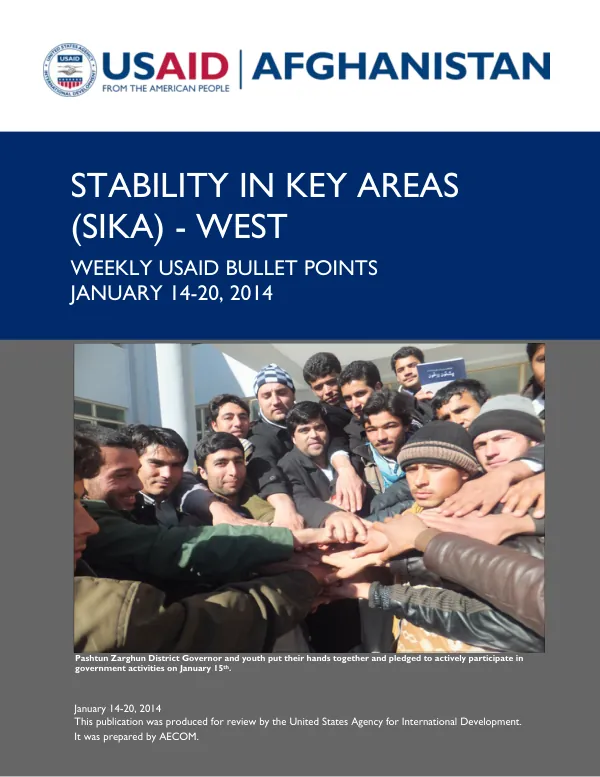
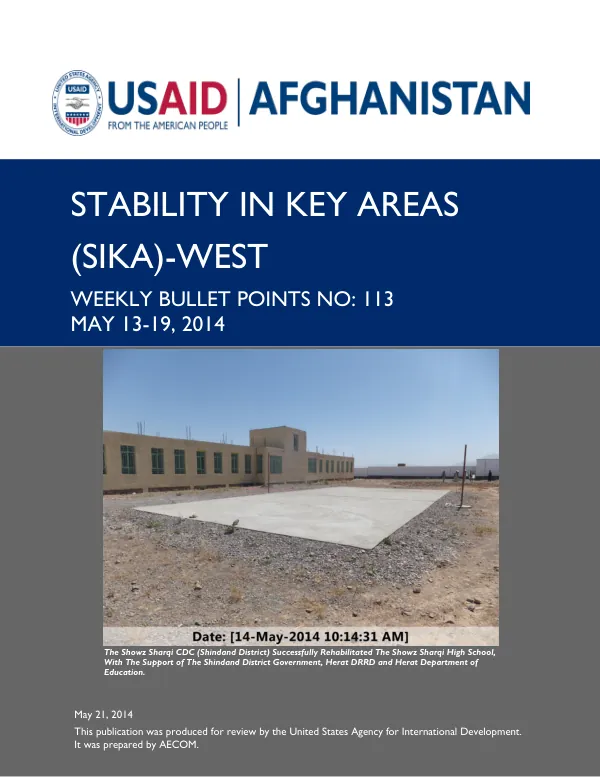
The program focuses on capacity building and coordination among local government officials, community development councils (CDCs), and other stakeholders. Capacity building and coordination efforts are underway in several districts, including Bala Boluk, Pashtun Zarghun, Shindand, Khak-e-Safayd, and Qadis. Training sessions have been conducted on topics such as work plan development, meeting management skills, and stability analysis mechanism (SAM). These training sessions have been attended by government officials, CDC staff, and other stakeholders. In Bala Boluk District, training on work plan development was provided to nine district government staff, who also received one-on-one mentoring and coaching to prepare their work plans. In Pashtun Zarghun District, one-on-one mentoring on work plan development was provided to seven district government staff, who developed their work plans and sent them to the district governor for review and approval. Meeting management skills training was provided to 15 Khak-e-Safayd District Government staff, covering topics such as agenda preparation, minutes taking, and effective meeting organization. In Qadis District, a pre-DSC meeting and training were provided to the district governor, admin manager, executive manager, and DRRD social worker. Community development councils (CDCs) are implementing various projects in Bala Boluk and Pashtun Zarghun Districts, including labor-intensive rehabilitation grants, vocational training courses, and infrastructure development projects. In Badghis Province, an inter-district meeting was held with the participation of 66 people, including district governors, executive managers, and influential people from Qadis, Muqur, and Ab-Kamari Districts. The meeting discussed topics such as security, development, and conflict resolution, with the Ab-Kamari district governor highlighting the role of the people in bringing peace and stability to the community. In Muqur District, a meeting was organized with representatives of the Afghan Civilian and Esalat Youth Associations, where youth shared their concerns and the district governor pledged to improve education services and asked the youth to cooperate with the district government. The Muqur Tribal Conflict Resolution Committee (TCRC) successfully resolved a conflict between the Hichka and Kalan Khana villages, which had been ongoing since 2003. The conflict was resolved peacefully through a meeting organized by the TCRC, and an agreement letter was signed by the conflicting parties. Overall, the SIKA –West initiative is making progress in promoting stability and development in western Afghanistan through capacity building and coordination efforts, community development projects, and conflict resolution initiatives.