USAID
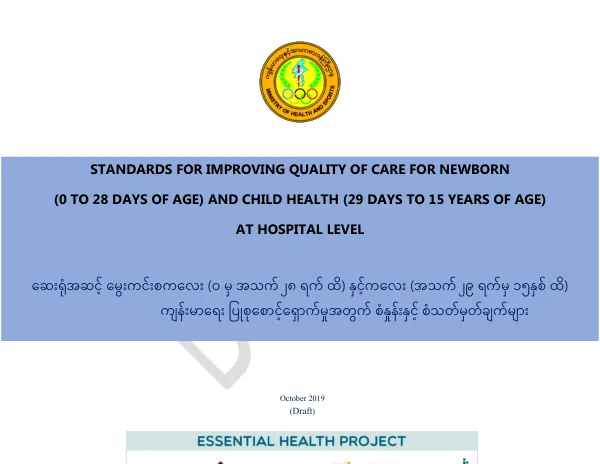
Standards for Improving Quality of Care for Newborn Health At Hospital Level
The standards for improving quality of care for newborn and children at hospital level are outlined in a document that emphasizes the importance of providing routine, evidence-based care and management of complications during the early postnatal period.
2019 · 216 pages
Sign in to readA free account is required to download.
Abstract
The document is divided into several sections, each addressing a specific aspect of newborn care. Standard I: Every newborn receives routine, evidence-based care and management of complications during the early postnatal period, according to national guidelines. This includes immediate skin-to-skin contact at birth, drying of the newborn immediately and thoroughly, and assessment of vital signs. The document outlines several indicators to measure the quality of care provided to newborns, including the proportion of newborns who received immediate skin-to-skin contact at birth, the proportion of newborns who were dried immediately and thoroughly, and the proportion of newborns who had a normal body temperature at the first complete examination. The health facility is also expected to have written clinical protocols for essential newborn care that are consistent with national guidelines and available in the labor and childbirth areas. Additionally, the facility must ensure that there is sufficient quantity of clean towels/cloths at the time of labor and childbirth for immediate drying of newborns. Health-care staff in the labor and childbirth areas are required to receive in-service training or regular refresher sessions or CME in essential newborn care and breastfeeding support at least once every 12 months. The staff must also practice at least quarterly drills or simulation exercises in essential newborn care and supporting breastfeeding. Standard II: Newborns receive routine postnatal care, which includes a written breastfeeding protocol or guideline that is routinely communicated to all health care staff, women, and family members. The health facility must also have written clinical protocols for postnatal care that are consistent with national guidelines. The document outlines several indicators to measure the quality of care provided to newborns, including the proportion of newborns who received vitamin K and vaccination according to national guidelines, the proportion of stable newborns who are fed exclusively on breast milk from birth to discharge, and the proportion of newborns who received vitamin K injection. Health care staff practices and arranges rooming-in to allow mothers and babies to remain together 24 hours a day. All newborns delivered in the health facility must receive full clinical examination before discharge, including assessment of respiration, body weight, and other vital signs. The document emphasizes the importance of providing high-quality care to newborns and children, and outlines several standards and indicators to measure the quality of care provided. The standards are designed to ensure that newborns receive routine, evidence-based care and management of complications during the early postnatal period, and that health care staff are trained and equipped to provide high-quality care. The document also emphasizes the importance of breastfeeding support and outlines several indicators to measure the quality of breastfeeding support provided to mothers and newborns. The standards are designed to ensure that mothers and newborns receive high-quality breastfeeding support, including written breastfeeding protocols or guidelines, and that health care staff are trained and equipped to provide breastfeeding support. Overall, the document provides a comprehensive framework for improving the quality of care provided to newborns and children at hospital level, and emphasizes the importance of providing routine, evidence-based care and management of complications during the early postnatal period.
Related documents