USAID DEC
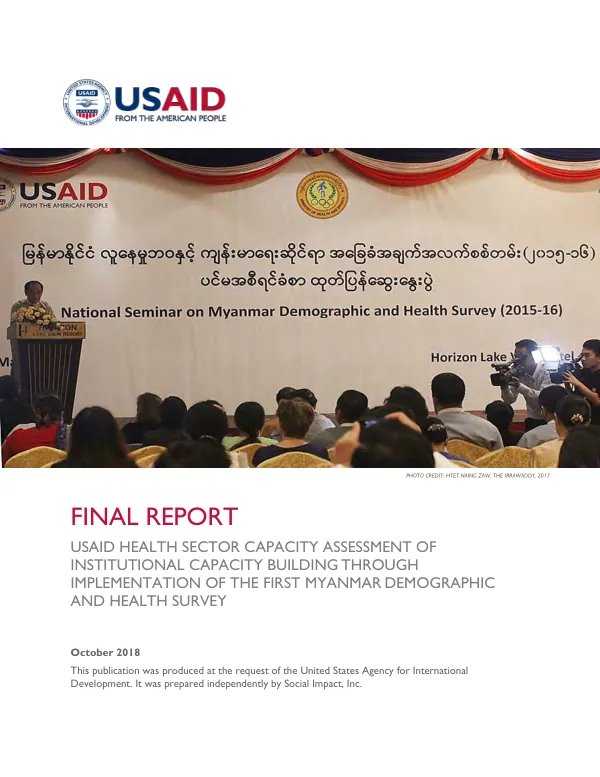
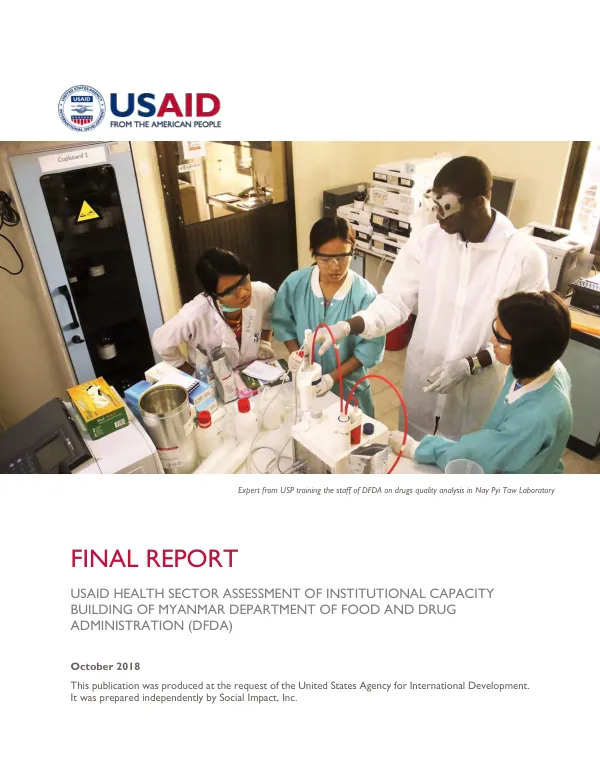
USAID HEALTH SECTOR ASSESSMENT OF INSTITUTIONAL CAPACITY BUILDING OF MYANMAR DEPARTMENT OF FOOD AND DRUG ADMINISTRATION (DFDA)
Sign inSOCIAL IMPACT, INC.
USAID HEALTH SECTOR ASSESSMENT OF INSTITUTIONAL CAPACITY BUILDING OF MYANMAR DEPARTMENT OF FOOD AND DRUG ADMINISTRATION (DFDA)
The USAID Health Sector Assessment of Institutional Capacity Building of Myanmar's Department of Food and Drug Administration (DFDA) was conducted in October 2018.
2018 · 68 pages
Sign in to readA free account is required to download.
Abstract
The assessment aimed to evaluate the institutional capacity of the DFDA to monitor drug quality, with a focus on the Promoting the Quality of Medicines (PQM) program implemented by the United States Pharmacopeial Convention (USP). The assessment was conducted by a two-person team from Social Impact, Inc. The assessment found that the DFDA's institutional capacity was strengthened to monitor drug quality as a result of USAID assistance. The DFDA's Pharmaceutical Chemistry Laboratory in Nay Pyi Taw achieved ISO 17025 accreditation earlier than anticipated, which was a significant success. The assessment highlighted the importance of government resource mobilization, PQM's state-of-the-art facilitative support, and the government's commitment to leveraging external institutional strengthening support. The assessment also identified key factors that contributed to the success of the Drug Quality Monitoring Activity. These included implementing partner approaches that built on local strengths, fostered trust and rapport with government counterparts, and supported the institutionalization of sustainable capacity-building and quality assurance mechanisms. The assessment concluded that the DFDA's capacity to monitor drug quality was strengthened, and the government's commitment to quality assurance was demonstrated. The assessment team acknowledged the support of various stakeholders, including the Promoting the Quality of Medicines program, the Department of Food and Drug Administration, and USAID staff. The team also recognized the importance of the government's investment in the DFDA's development and the commitment to leveraging external institutional strengthening support. The assessment identified several lessons that can be learned and applied to other future programs and activities in Myanmar. These included the importance of building on local strengths, fostering trust and rapport with government counterparts, and supporting the institutionalization of sustainable capacity-building and quality assurance mechanisms. The assessment also highlighted the need for continued support to the DFDA to ensure the sustainability of the gains made. The assessment was conducted in accordance with the assessment scope of work, which included a review of relevant documents, key informant interviews, and data collection tools. The assessment team consisted of two members from Social Impact, Inc., who were supported by USAID staff and other stakeholders. The assessment was conducted in July-August 2018, and the final report was submitted in October 2018. The assessment identified several challenges and limitations, including the need for continued support to the DFDA to ensure the sustainability of the gains made. The assessment also highlighted the importance of monitoring and evaluation to ensure that the gains made are sustained over time. The assessment concluded that the DFDA's capacity to monitor drug quality was strengthened, and the government's commitment to quality assurance was demonstrated. The assessment team recommended several actions to build on the gains made, including continued support to the DFDA, the implementation of quality assurance mechanisms, and the monitoring and evaluation of the gains made. The assessment concluded that the DFDA's capacity to monitor drug quality was strengthened, and the government's commitment to quality assurance was demonstrated.
Related documents