USAID
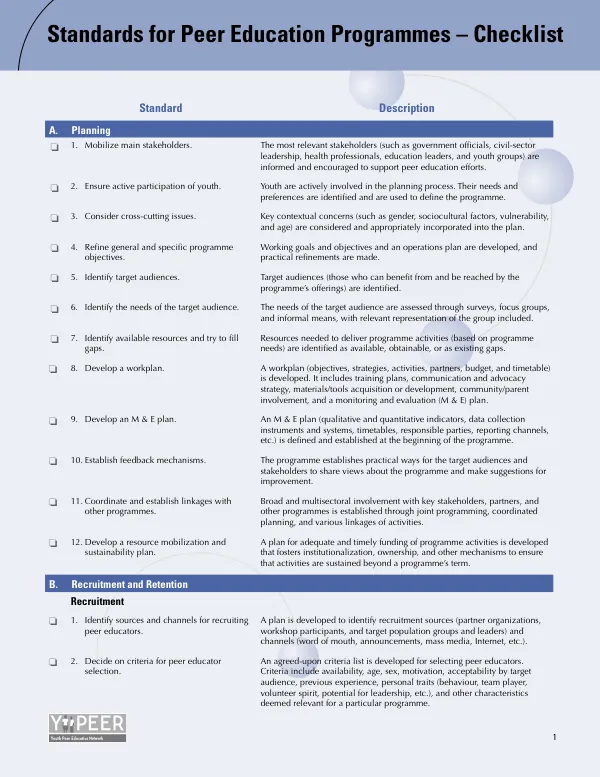
Standards for Peer Education Programmes – Checklist
Mobilization of stakeholders is a crucial step in the planning process of a peer education programme.
4 pages
Sign in to readA free account is required to download.
Abstract
Relevant stakeholders, including government officials, civil-sector leaders, health professionals, education leaders, and youth groups, are informed and encouraged to support peer education efforts. This involves active participation of youth in the planning process, where their needs and preferences are identified and used to define the programme. Key contextual concerns, such as gender, sociocultural factors, vulnerability, and age, are considered and incorporated into the plan. Working goals and objectives, as well as an operations plan, are developed, and practical refinements are made. Target audiences are identified, and their needs are assessed through surveys, focus groups, and informal means, with relevant representation of the group included. The programme's available resources are identified, and gaps are filled. A workplan is developed, including objectives, strategies, activities, partners, budget, and timetable. It includes training plans, communication and advocacy strategy, materials/tools acquisition or development, community/parent involvement, and a monitoring and evaluation (M & E) plan. An M & E plan is defined and established at the beginning of the programme, with qualitative and quantitative indicators, data collection instruments and systems, timetables, responsible parties, reporting channels, and other necessary components. Feedback mechanisms are established to allow target audiences and stakeholders to share views about the programme and make suggestions for improvement. The programme establishes linkages with other programmes through joint programming, coordinated planning, and various activities. A resource mobilization and sustainability plan is developed to ensure adequate and timely funding of programme activities, fostering institutionalization, ownership, and other mechanisms to sustain activities beyond the programme's term. Recruitment and retention of peer educators are critical components of the programme. A plan is developed to identify recruitment sources and channels, and criteria for peer educator selection are established. Clear expectations are documented for both the programme and prospective peer educators, and a standardized and transparent interview and selection process is implemented. Expectations for peer educators' activities and performance are clarified, agreed upon, and documented in writing. Continuous communication mechanisms are established between peer educators and programme supervisors and managers, including regular feedback via supervision, regular peer educator/management meetings, and an annual retreat. An incentives system is established, including recognition, awards, and rewards, as well as social and recreational opportunities, exchange and travel opportunities, and advancement within the group. Supervisory and mentoring systems are in place, with mentoring provided as possible. Trained and qualified trainers are arranged to deliver the training, and a quality training curriculum is selected that is consistent with the programme's topics and approach, culturally appropriate and gender sensitive, interactive and participatory, and well structured and sequenced in feasible time allocations. The training is carried out in appropriately sized groups, with subjects and exercises given appropriate time according to relevance and trainees' levels of knowledge and skills. Interactive, participatory, and skills development approaches are used, and mechanisms for assessing trainees' knowledge and skill development are in place at the onset of training and used at the conclusion of the training. Ethical issues are discussed as part of the training, and youth are involved in all aspects of the training design, implementation, and evaluation. Supervisors are trained in supervision skills, programme expectations, and peer education content and approaches, and they ensure that peer educators have received adequate preparation before they begin their work. Supervisors continually reinforce peer educator motivation, monitor limitations, reinforce compliance with the code of ethics, and monitor sensitivity to gender and cultural concerns. They manage the group dynamic, encourage team building, promote a safe environment, and stay aware of personal relationships. Supervisors share supervision and responsibilities with peer educators and involve them as active participants in the supervision process, with feedback regularly invited. Management systematically monitors and assures compliance with programme standards and initiates corrective action when shortfalls are identified. Management has demonstrated technical competencies in specific areas appropriate to their responsibilities, including peer education strategies and methodologies, behaviour change communication (BCC) activities, and M & E. Management and peer educators establish guidelines and expectations about the quality of various peer education activities and develop remedies for situations when quality standards are not being met.