USAID
Staples Value Chain Activity – Baseline Report: Annex 4
The Nafaka Project Baseline Survey is a comprehensive household questionnaire designed to collect data on various aspects of household demographics, agricultural practices, and economic activities.
51 pages
Sign in to readA free account is required to download.
Abstract
The survey is divided into several sections, each focusing on a specific area of interest. The first section of the survey collects information on household member details, including name, age, sex, relationship to the household head, marital status, educational level, and occupation. The respondent is required to list all household members, with the household head appearing first on the list. The survey also includes a code list for relationship types, marital statuses, educational levels, and occupations to facilitate data entry. The second section of the survey focuses on plot and planting details, where households are required to list all plots owned or used by the household. The plots are listed in order of size, from largest to smallest, and include information on plot size, type, ownership, primary reason for not cultivating, watering method, main cultivated crop, intercropping, planting dates, time spent on land preparation and seeding, main land preparation method, amount spent on rental and fuel, type of seed used, amount of seed used, and amount spent on seed. The survey also includes a section for the survey supervisor to provide a quality rating for the survey and certify that the data was collected in accordance with the survey design and guidance. The supervisor is required to rate the quality of the survey as poor, average, or excellent and indicate whether they backchecked the survey. The Nafaka Project Baseline Survey is designed to collect data on various aspects of household demographics, agricultural practices, and economic activities, providing a comprehensive understanding of the household's situation and needs. The survey is an essential tool for the Nafaka Project, which aims to improve the livelihoods of rural households in Tanzania. The survey data will be used to identify areas of need and develop targeted interventions to address the challenges faced by rural households. The data will also be used to monitor the progress of the project and evaluate its impact on household livelihoods. The survey is conducted in various regions of Tanzania, including Dodoma, Manyara, Morogoro, and Zanzibar. The survey is designed to be completed by a household member, with the household head appearing first on the list. The survey is an essential tool for the Nafaka Project, which aims to improve the livelihoods of rural households in Tanzania. The survey is designed to be completed by a household member, with the household head appearing first on the list. The survey is an essential tool for the Nafaka Project, which aims to improve the livelihoods of rural households in Tanzania. The survey data will be used to identify areas of need and develop targeted interventions to address the challenges faced by rural households.
Related documents
Documents in this collection
 2012
2012USAID DEC
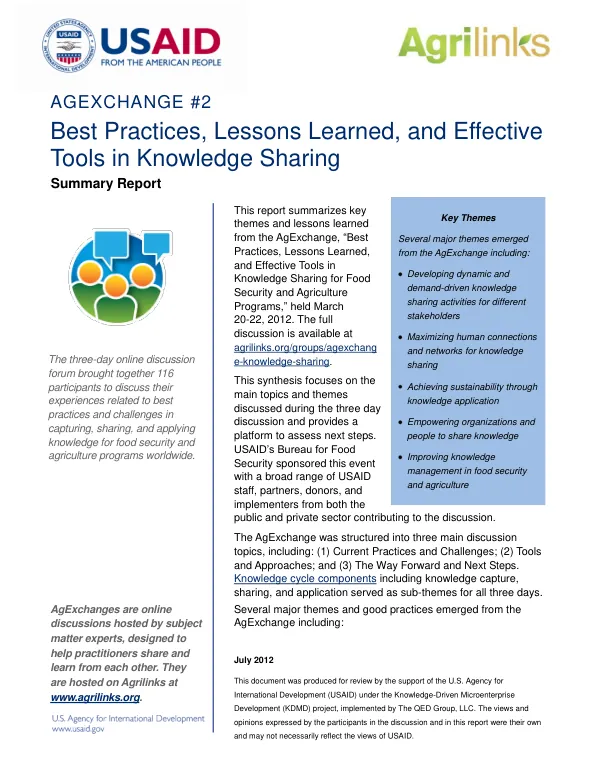
AgExchange #2: Best Practices, Lessons Learned, and Effective Tools in Knowledge Sharing for Food Security and Agriculture Programs
Open record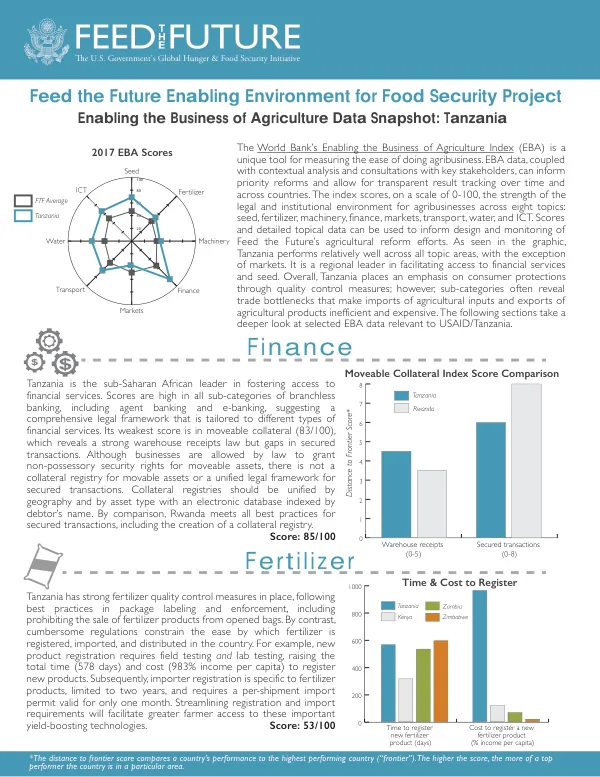 2017
2017USAID DEC
Feed the Future Enabling Environment for Food Security Project Enabling the Business of Agriculture Data Snapshot: Tanzania
Open record