TETRA TECH
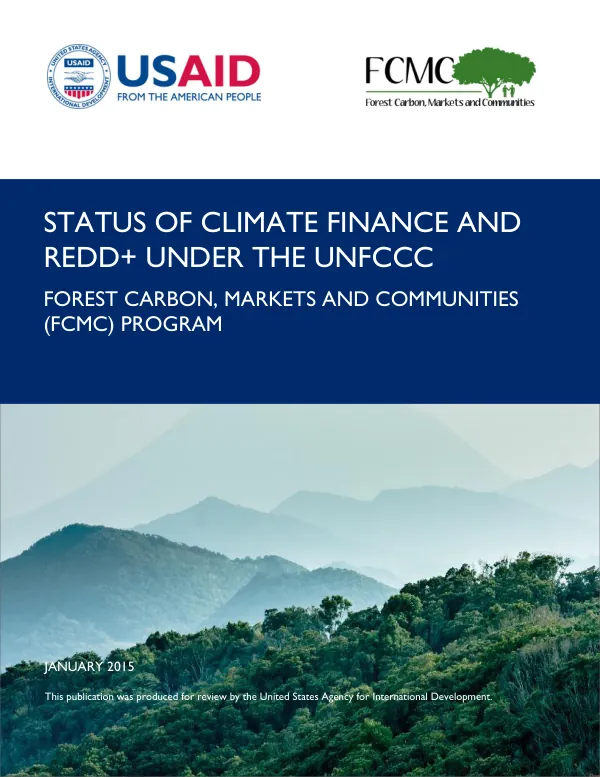
Status of Climate Finance and REDD+ Under the UNFCCC
The Forest Carbon, Markets and Communities (FCMC) Program was launched by the United States Agency for International Development (USAID) to provide assistance in developing and implementing Reducing Emissions from Deforestation and Forest Degradation, conservation of forest carbon stocks, sustainable management of forests and enhancement of forest carbon stocks (REDD+) initiatives.
2015 · 25 pages
Sign in to readA free account is required to download.
Abstract
The program offers analysis, evaluation, tools, and guidance for program design support, training materials, and meeting and workshop development and facilitation that support U.S. Government contributions to international REDD+ architecture. The FCMC Program was established to address the need for a comprehensive and inclusive set of REDD+ finance decisions. The program's services include analysis, evaluation, tools, and guidance for program design support, training materials, and meeting and workshop development and facilitation. The program's goal is to provide assistance to USAID missions, partner governments, and local and international stakeholders in developing and implementing REDD+ initiatives. The program's services are designed to support the development of REDD+ initiatives, including the development of national REDD+ strategies, the establishment of REDD+ programs, and the implementation of REDD+ activities. The program also provides training and capacity-building services to support the development of REDD+ initiatives. The FCMC Program is managed by Tetra Tech, a consulting firm that specializes in international development and environmental services. The program's management team includes experts in REDD+, climate change, and international development. The program's work is guided by the principles of the United Nations Framework Convention on Climate Change (UNFCCC), which defines a Financial Mechanism (FM) to provide financial resources to developing countries on a grant or concessional basis under the guidance of, and accountable to, the Conference of Parties (COP). The operation of the FM is currently entrusted to the Global Environment Facility (GEF) and the Green Climate Fund (GCF). The GEF already provides support for REDD+ and sustainable forest management, while the GCF is currently "up but not running," with its board having identified REDD+ implementation as one of the initial result areas of the fund. The GCF has adopted policies enabling the fund to allow contributors to provide pledges during the GCF's Initial Resource Mobilization period, which resulted in pledges of $10.2 billion as of 31 December 2014. In addition to the GEF and GCF, specialized funds have been established under the framework of the Convention, including the Special Climate Change Fund and the Adaptation Fund. A Standing Committee on Finance (SCF) was established in 2010 to assist the COP in exercising its functions with respect to the FM. Market-based mechanisms established by the Kyoto Protocol, such as the Clean Development Mechanism (CDM), have also been established to support the development of REDD+ initiatives. The CDM allows developed countries to invest in emission-reducing projects in developing countries and earn credits that can be used to meet their own emission reduction targets. The FCMC Program's work is focused on supporting the development of REDD+ initiatives, including the development of national REDD+ strategies, the establishment of REDD+ programs, and the implementation of REDD+ activities. The program's services are designed to support the development of REDD+ initiatives, including the development of national REDD+ strategies, the establishment of REDD+ programs, and the implementation of REDD+ activities. The program's work is guided by the principles of the UNFCCC, which defines a Financial Mechanism (FM) to provide financial resources to developing countries on a grant or concessional basis under the guidance of, and accountable to, the COP. The operation of the FM is currently entrusted to the GEF and the GCF.