TUSKEGEE UNIVERSITY. SCHOOL OF AGRICULTURE AND HOME ECONOMICS. DEPT. OF HOME ECONOMICS
Status of traditional food preservation methods for selected Ghanaian foods
Except for relatively shelf-stable crops such as the cereal and legume grains, Ghana"s foods tend to be either highly perishable or semiperishable.
Pace, Ralphenia D.; Plahar, Wisdom A. +1 more · 1970
Sign in to readA free account is required to download.
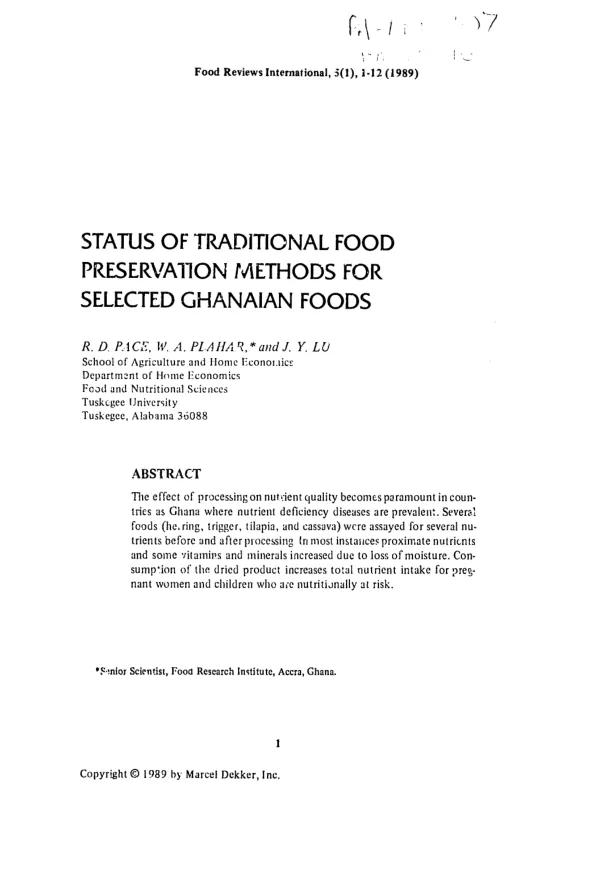
Abstract
The country"s warm and moist climate breeds insects, fungi, and bacteria which contribute to the deterioration of these foods, resulting in considerable postharvest food losses. This report describes Ghana"s traditional food preservation techniques and assesses their impact on the nutrient quality of three kinds of fish (herring, trigger, and tilapia) and of cassava, the country"s most perishable root crop. Dehydration, smoking, salting, and fermentation (used either singly or in combination) are the most common traditional processes. Use of these techniques on fish and cassava almost always lowers their moisture content and thereby increases nutrient concentration - a matter of great importance in a country such as Ghana, where nutrient deficiency diseases are prevalent. While fruits and vegetables are among the foods not traditionally preserved, Ghana"s Food Research Institute has developed simple home canning and drying techniques for these foodstuffs, including solar drying of eggplant, okra, pepper, and spinach. Studies have also been carried out on the preservation of local fruits through the manufacture of jams, marmalades, fruit juices, and wines.
Connected topics
Related documents