USAID DEC
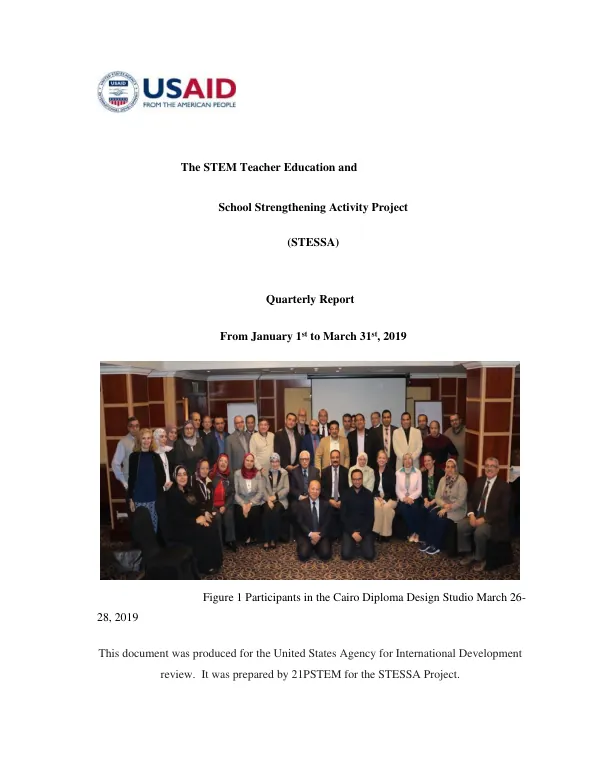
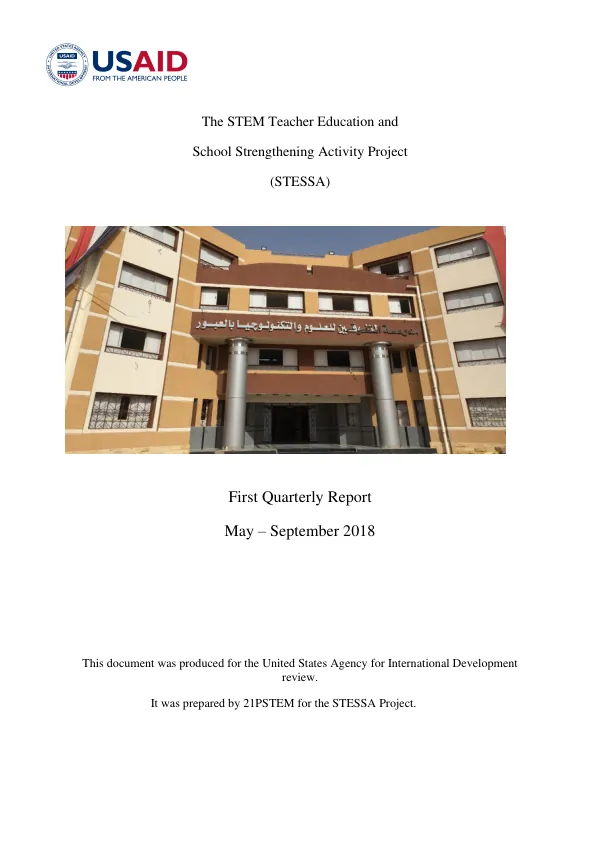
STEM Teacher Education and School Strengthening Activity Project (STESSA) First Quarterly Report May – September 2018
Sign inMINISTRY OF EDUCATION
STEM Teacher Education and School Strengthening Activity Project (STESSA) First Quarterly Report May – September 2018
The STEM Teacher Education and School Strengthening Activity Project (STESSA) is a project initiated by the 21st Century Partnership for STEM Education (21PSTEM) in partnership with the United States Agency for International Development (USAID).
2018 · 18 pages
Sign in to readA free account is required to download.
Abstract
The project aims to strengthen STEM education in Egypt by focusing on two main components: STEM teacher education and school strengthening. Component I of the project focuses on STEM teacher education, which involves partnering with faculties of education and faculties of science and engineering to provide training and capacity building for teachers. The project team conducted a meeting with the Head and members of the Educational Sector Planning Committee to introduce the new STESSA project and familiarize them with its aspects. A visit to the 6th October STEM School was also arranged to showcase the STEM teaching and learning model. Component II of the project focuses on school strengthening, which involves institutionalizing and sustaining high-quality STEM schools through the Ministry of Education (MOE) and Local STEM Unit levels. The project team conducted training for school leaders, teachers, and trainers, and also met with training coordinators to review and finalize training material. A preparatory meeting was held to discuss the outcome of the meeting, which resulted in three action steps: using e-STEM units to enhance the English component, ensuring that activities could be completed within the time limit, and reducing the anxiety of first-year students by focusing on soft skills and integrated English. Monitoring and evaluation activities are also ongoing, with the first activity being the Knowledge, Attitude, and Practice (KAP) Baseline Survey. The survey aims to understand teachers' knowledge, beliefs, and practices regarding STEM school curriculum, assessment system, and pedagogy. A tool has been developed and is expected to be disseminated in November to all teachers. Project operations have also been established, with an Egyptian bank account obtained by the STESSA field office and full financial operations established. A lease for the Cairo field office has been signed, and office furnishing and equipment have been procured and installed. Home office staff have been hired, and the field office is in the process of becoming fully staffed. The technical work of the project has begun and is progressing according to the Annual Work Plan (AWP) timeline. The project team has established its operating policies for finance, procurement, IT support, travel, and HR. Personnel recruitment has been advertised in a newspaper ad, and around 800 applicants have applied to the different positions through the HR mail. The project has made significant progress in its first quarter, with various activities carried out to establish the project's office in Cairo, formalize paperwork for field office staff, and establish its operating policies. The project team has also conducted training for school leaders, teachers, and trainers, and has met with training coordinators to review and finalize training material. The project is expected to continue making progress in the coming quarters, with a focus on implementing its activities and achieving its performance results and indicators.