MINISTRY OF EDUCATION
EdData II: Egypt Grade 3 Early Grade Reading – Pilot Group Assessment
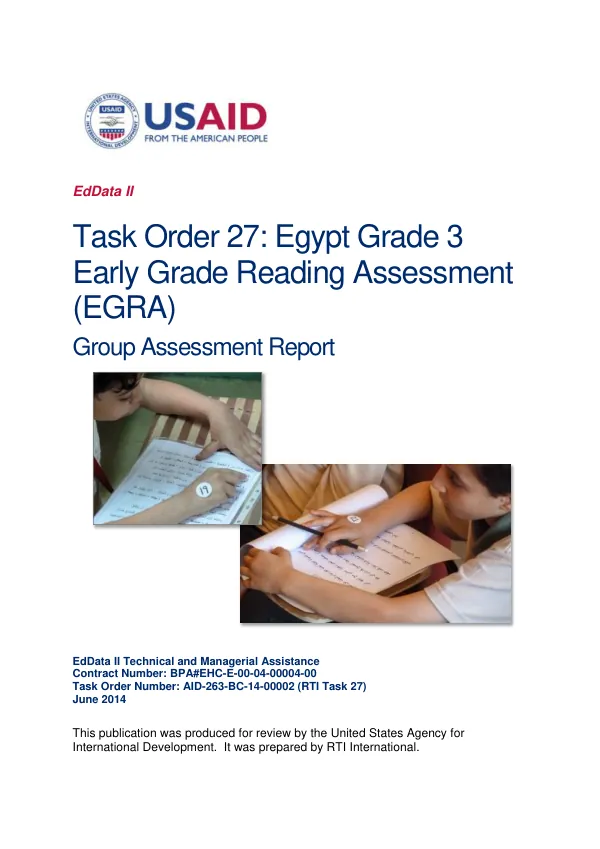
The Early Grade Reading Assessment (EGRA) pilot group assessment in Egypt was conducted in June 2014 as part of the EdData II program.
2014 · 51 pages
Sign in to readA free account is required to download.
Abstract
The assessment aimed to evaluate the reliability of the group assessment tool in measuring early grade reading skills among Grade 3 students. A total of 200 students from six schools in Greater Cairo were sampled for the pilot, with 195 student observations used for analysis. The participating schools were selected by the Ministry of Education (MOE) for their availability of empty classrooms or auditoriums. The group assessment tool was developed by RTI International with technical assistance from Medina Korda and Drs. Jonathon Stern, Amy D. Mulcahy-Dunn, and Margaret Dubeck. The tool was designed to assess reading skills among students in a group setting, with the goal of determining whether the group assessment could be a viable alternative to individual assessments. The assessment consisted of several subtasks, including non-word reading, oral reading fluency (ORF), and reading comprehension. The results of the pilot group assessment showed that the group assessment tool demonstrated acceptable internal consistency, with a Cronbach's alpha coefficient of 0.83 for the non-word reading subtask and 0.85 for the ORF subtask. The concurrent validity of the group assessment was also evaluated, with results indicating a strong correlation between the group assessment and individual assessment scores. The results of the pilot group assessment suggested that the group assessment tool could be a reliable and valid measure of early grade reading skills among Grade 3 students in Egypt. The pilot group assessment also identified several key challenges and benefits associated with the group assessment approach. One of the main challenges was the need for careful training and preparation of assessors to ensure that the group assessment was administered consistently and accurately. However, the benefits of the group assessment approach included the ability to assess large numbers of students in a relatively short period of time, as well as the potential for increased efficiency and cost-effectiveness. The results of the pilot group assessment have implications for the implementation of the EGRA program in Egypt. The findings suggest that the group assessment tool could be a valuable addition to the EGRA program, providing a more efficient and cost-effective way to assess early grade reading skills among Grade 3 students. However, further research is needed to fully evaluate the validity and reliability of the group assessment tool and to identify strategies for implementing the group assessment approach in a large-scale assessment program.
Related documents