USAID DEC
STIP/M&E Event Summary
The STIP/M&E Event Summary, hosted by USAID/Central Asia, took place from July 13-15, 2015.
2015 · 2 pages
Sign in to readA free account is required to download.
Abstract
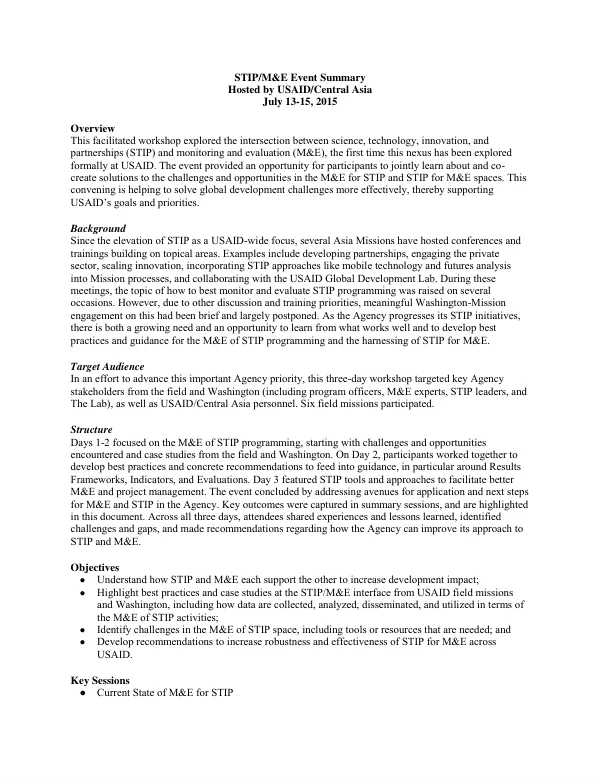
This facilitated workshop explored the intersection between science, technology, innovation, and partnerships (STIP) and monitoring and evaluation (M&E), with the goal of increasing development impact. The event provided an opportunity for participants to jointly learn about and co-create solutions to the challenges and opportunities in the M&E for STIP and STIP for M&E spaces. The workshop targeted key Agency stakeholders from the field and Washington, including program officers, M&E experts, STIP leaders, and personnel from USAID/Central Asia. Six field missions participated in the event. The structure of the workshop included Days 1-2 focusing on the M&E of STIP programming, starting with challenges and opportunities encountered and case studies from the field and Washington. On Day 2, participants worked together to develop best practices and concrete recommendations to feed into guidance, in particular around Results Frameworks, Indicators, and Evaluations. The objectives of the workshop were to understand how STIP and M&E each support the other to increase development impact, highlight best practices and case studies at the STIP/M&E interface from USAID field missions and Washington, identify challenges in the M&E of STIP space, and develop recommendations to increase robustness and effectiveness of STIP for M&E across USAID. Key sessions included the Current State of M&E for STIP, Results Frameworks for STIP Programs, Indicators for STIP Programs, Strengthening the STIP Theory of Change, Building the M&E for STIP Toolkit, and Using STIP to Enhance M&E and Performance Management. The workshop tookaways emphasized the importance of building a USAID STIP M&E Community of Practice (COP) to advance effectively STIP and the STIP/M&E nexus. This COP should be action-oriented, working together on priority STIP M&E tasks, and could do so through a virtual TDY. The event also highlighted the need to integrate further STIP/M&E across USAID, champion "Spatial Thinking," and increase STIP M&E Agency-wide resources. Next steps included developing a USAID STIP 101 Online Training, launching a STIP/M&E Agency-wide Resource site, modifying the STIP Theory of Change based on event discourse, working through the COP and "Virtual TDY" to revise relevant F standard indicators, attending and supporting the December 2015 STIP Event, and building a similar training module for individual missions/regional convenings, expanding to include implementing partners. Current resources include the workshop presentations and notes, which can be found in a Google Folder, and a link to the STIP M&E resource site, which will be shared with the Agency once available.
Related documents