USAID DEC
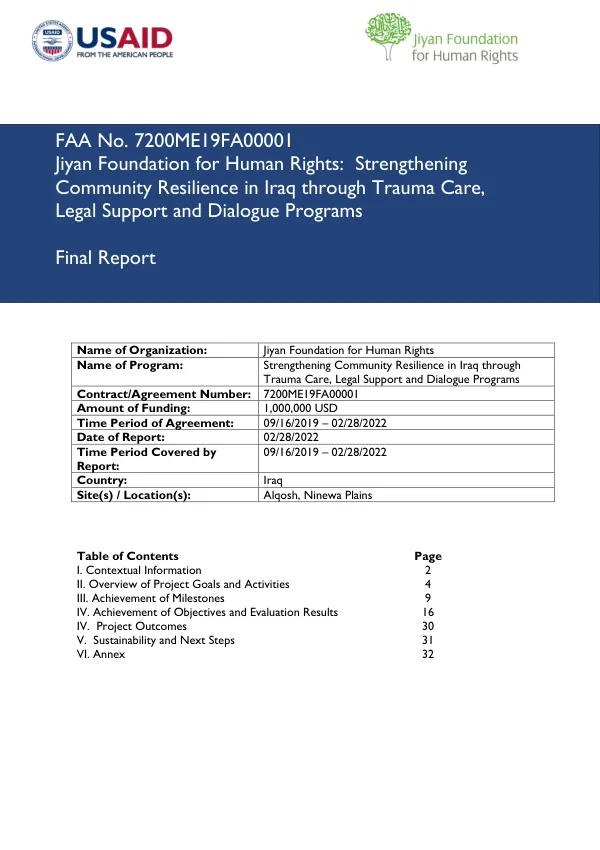
Strengthening Community Resilience in Iraq through Trauma Care, Legal Support and Dialogue Programs
Sign inUSAID DEC
Strengthening Community Resilience in Iraq through Trauma Care, Legal Support and Dialogue Programs
The Jiyan Foundation for Human Rights implemented the Strengthening Community Resilience in Iraq through Trauma Care, Legal Support and Dialogue Programs project in the Ninewa Plains region of Iraq.
2022 · 34 pages
Sign in to readA free account is required to download.
Abstract
The project aimed to enhance community resilience and recovery, as well as promote self-reliance for those impacted by ISIS atrocities. The project's main goal was achieved through three key interventions: improving the mental health of survivors of atrocities perpetrated by ISIS through trauma rehabilitation and resilience services, increasing survivors' ability to thrive in post-conflict Iraq through legal services and justice/reparations programing, and promoting community cohesion and resilience through interreligious and interethnic dialogue. The project activities were mainly conducted in Telkayf district and Shekhan district through the Jiyan Foundation center located in Alqosh town, in addition to Khanke camp in Duhok governorate. The team of Jiyan Foundation implemented awareness raising activities to reach out to people who had no information about Jiyan services or about mental health issues in general. The psychotherapists of Jiyan were the facilitators of these awareness raising sessions, which were conducted in coordination between Jiyan Foundation and the health department and camp managers in the region of implementation. Mental health and psychosocial services were provided to the local communities of Telkayf and Shekhan districts as well as for IDPs in the region, living on the villages or towns. The services included psychotherapy sessions, which were conducted in person or remotely, depending on the client's preference and circumstances. The team also provided legal services and justice/reparations programing to survivors of atrocities perpetrated by ISIS. The project faced several challenges, including the COVID-19 pandemic, which had a significant impact on the implementation of project activities. The pandemic led to the closure of Jiyan Foundation centers, suspension of group activities, and restrictions on travel and gatherings. However, the team was able to adapt to the situation and continue providing services to clients through remote means. Despite the challenges, the project made significant progress in achieving its goals. The team was able to reach out to a large number of people through awareness raising activities, and the number of clients receiving mental health and psychosocial services increased significantly. The project also made progress in promoting community cohesion and resilience through interreligious and interethnic dialogue. The project's impact was evaluated through various indicators, including the number of clients receiving services, the number of awareness raising activities conducted, and the level of community cohesion and resilience. The evaluation results showed that the project was successful in achieving its goals and making a positive impact on the community. The project was implemented from September 2019 to February 2022, with a budget of 1,000,000 USD provided by USAID. The project was implemented in partnership with local authorities and stakeholders, and the team worked closely with them to ensure the success of the project. The project's success was also attributed to the dedication and hard work of the team, who were able to adapt to the challenges and continue providing services to clients despite the difficulties. The project's sustainability was ensured through the development of a plan for the continuation of services after the project's end. The plan included the establishment of a community-based mental health and psychosocial support system, which would provide services to clients even after the project's end. The plan also included the training of local staff to provide mental health and psychosocial services, which would ensure the continuation of services even after the project's end. In conclusion, the Strengthening Community Resilience in Iraq through Trauma Care, Legal Support and Dialogue Programs project was a successful initiative that made a positive impact on the community. The project's success was attributed to the dedication and hard work of the team, who were able to adapt to the challenges and continue providing services to clients despite the difficulties. The project's sustainability was ensured through the development of a plan for the continuation of services after the project's end.
Related documents