USAID DEC
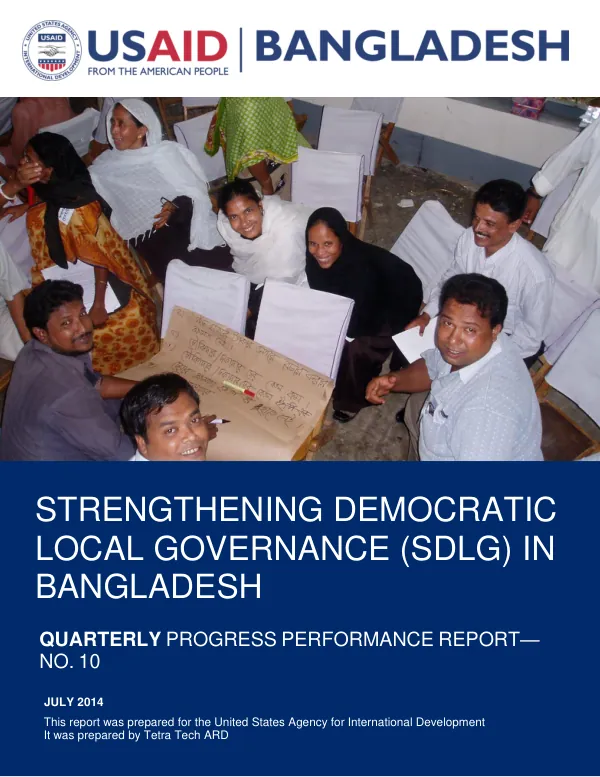
Strengthening Democratic Local Governance (SDLG) in Bangladesh: Quarterly Progress Performance Report—No. 10
Sign inTETRA TECH ARD, INC.
Strengthening Democratic Local Governance (SDLG) in Bangladesh: Quarterly Progress Performance Report—No. 10
The Strengthening Democratic Local Governance (SDLG) Project in Bangladesh is a 51-month activity funded by the United States Agency for International Development's Bangladesh Mission.
2014 · 19 pages
Sign in to readA free account is required to download.
Abstract
The project aims to expand the roles and authorities of local governments, strengthen local government associations, improve service delivery and resource mobilization of local government units, and ensure public participation, accountability, and transparency in local government finances and decision-making. The SDLG Project combines research and policy advocacy, capacity development for local government associations, and training and technical assistance for local government units at union parishad, upazila parishad, and pourashava levels. Tetra Tech ARD is the implementing partner for the SDLG Project. Major SDLG Project objectives include expanding the roles and authorities of local governments, stimulating evidence-based policy dialogue at the national level, and demonstrating the benefits to policymakers. The project also aims to strengthen and expand the capacity of local government associations, work with existing union and municipal local government associations to articulate emerging policy dialogue issues and advocate for legal and policy reform, and help form a unified association of upazilas. The project's technical strategy involves building on USAID/Bangladesh's history of local governance support programs, linking with USAID/Bangladesh's and other donor's programs, integrating global and local lessons learned and proven tools for successful and sustainable local governance programming, and identifying, developing, and demonstrating to local governments innovative practices to improve performance. In the extension period, Component 1: Roles and Authorities of Local Governments features research and advocacy events designed to support detailed understanding by relevant Government of Bangladesh officers and development partners of the role of upazila and union councils and their standing committees in improving GoB delivered sector services. Activities also identify pending policy reforms needed to support effective functioning of elected council oversight of such services. A National Conference on Upazila Policy and Practice was held in late June, featuring case studies focusing on health, agriculture, human rights, and climate change-related services. Activities under this component are conducted under a grant cost extension approved for SDLG research partner Unnayan Shamannay (US) for the 2014-15 extension year. Component 2: Transparent and Effective Service Delivery by Local Governments aims to improve and expand the service delivery and resource mobilization of local government units. Activities under this component include improving LGU management performance, enhancing LGU-sector collaboration for service delivery, and increasing citizen oversight of LGUs and sector service delivery. Component 3: Citizen Participation in Local Decision-Making aims to ensure public participation, accountability, and transparency in local government finances and decision-making. Activities under this component include improving citizen participation in local governance, increasing citizen oversight of LGUs and sector service delivery, and acquiring, developing, and disseminating information on the SDLG and local governments in Bangladesh. Cross-cutting themes and approaches include linking SDLG with USAID's sector programs, communication, gender and youth, and monitoring and evaluation. The project is providing support to USAID objectives under its Presidential Initiatives, including GHI, FtF, and GCC, linking USAID sector project activities in health, agriculture, human rights, and climate change to local government structures to improve their effectiveness and sustainability. The SDLG Project is organized to provide information on project performance in relationship to the Extension Year Work Plan. The report is organized according to the Extension Year Components, subsidiary Task Areas, and proposed Activities under each Task Area.
Related documents