USAID DEC
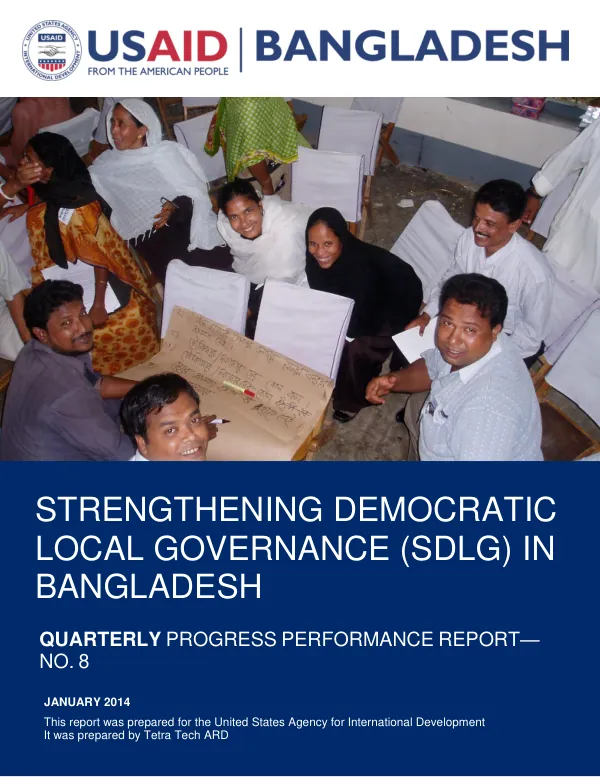
Strengthening Democratic Local Governance (SDLG) in Bangladesh: Quarterly Progress Performance Report—No. 8
Sign inTETRA TECH ARD, INC.
Strengthening Democratic Local Governance (SDLG) in Bangladesh: Quarterly Progress Performance Report—No. 8
The Strengthening Democratic Local Governance (SDLG) in Bangladesh Project is a 39-month activity funded by the USAID/Bangladesh Mission.
2014 · 19 pages
Sign in to readA free account is required to download.
Abstract
The project aims to expand the roles and authorities of local governments, strengthen and expand the capacity of local government associations, improve and expand the service delivery and resource mobilization of local government units, and ensure public participation, accountability, and transparency in local government finances and decision making. The project has combined a focus on research and policy advocacy, capacity development for local government associations, and training and technical assistance for local government units at union parishad, upazila parishad, and municipal levels. Tetra Tech ARD is the implementing partner for the SDLG Project. Major SDLG Project objectives are to: - Expand the roles and authorities of local governments by stimulating evidence-based policy dialogue at the national level, testing and disseminating innovative practices and partnerships with local governments, and demonstrating the benefits to policymakers. - Strengthen and expand the capacity of local government associations by working with existing union and municipal local government associations to articulate emerging policy dialogue issues and advocate for legal and policy reform on behalf of their constituencies. - Improve and expand the service delivery and resource mobilization of local government units by working to expand existing capacities of Union Parishads (UPs) and municipalities and helping the newly forming Upazila-level governments to understand and utilize their service delivery and resource mobilization authorities. - Ensure public participation, accountability, and transparency in local government finances and decision making by increasing the participation of citizens, including women and youth, through citizen participation forums, newly legislated Ward Committees, Open Budget meetings, and activated Standing Committees and other local participatory strategies. The project's technical strategy involves building on USAID/Bangladesh's history of local governance support programs, linking with USAID/Bangladesh's and other donor's programs, integrating global and local lessons learned and proven tools for successful and sustainable local governance programming, identifying, developing, and demonstrating to local governments innovative practices to improve performance, integrating gender and youth concerns across the SDLG program while supporting women's participation, and acquiring, developing, and disseminating through multiple media information on the SDLG and local governments in Bangladesh. Component 1: Roles and Authorities of Local Governments combines research, advocacy events, and behind-the-scenes efforts to build policy maker consensus on specific reforms designed to increase local government authority. In early 2013, SDLG selected research partner Unnayan Shamannay (US) through a competitive process to research local government advocacy activities, arrange private advocacy sessions, perform 'best practice' field research, and organize a national conference. Component 2: Advocacy and Capacity Building of Local Government Associations aims to strengthen and expand the capacity of local government associations by working with existing union and municipal local government associations to articulate emerging policy dialogue issues and advocate for legal and policy reform on behalf of their constituencies. Achievements in this component include training and technical assistance for local government associations, operational support services, and partnership building. Component 3: Transparent and Effective Service Delivery by Local Governments aims to improve and expand the service delivery and resource mobilization of local government units by working to expand existing capacities of Union Parishads (UPs) and municipalities and helping the newly forming Upazila-level governments to understand and utilize their service delivery and resource mobilization authorities. Achievements in this component include training and technical assistance for local government units, infrastructure development, and market linkage facilitation. Component 4: Citizen Participation in Local Decision-Making aims to ensure public participation, accountability, and transparency in local government finances and decision making by increasing the participation of citizens, including women and youth, through citizen participation forums, newly legislated Ward Committees, Open Budget meetings, and activated Standing Committees and other local participatory strategies. Achievements in this component include developing citizen participation forums, training and technical assistance for local government units, and partnership building. Component 5: Windows of Opportunity aims to identify and capitalize on opportunities for local government reform and development. Achievements in this component include research and analysis, policy dialogue, and partnership building. The report is organized to provide information on project performance in relationship to the Year 3 Work Plan. The project work plans were organized according to broad Components, subsidiary Task Areas, and proposed Activities under each Task Area.
Related documents