USAID. MISSION TO BOLIVIA
Strengthening financial markets (SFM) : securities exchange component
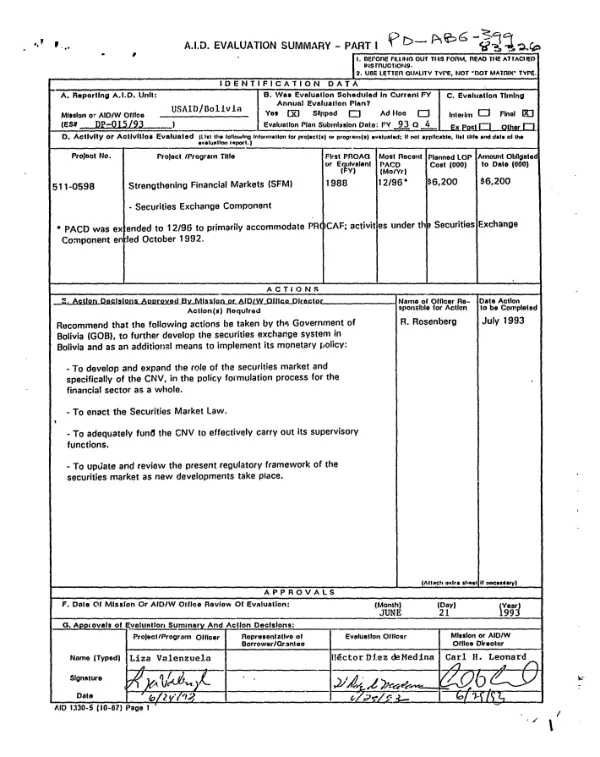
Summarizes final evaluation (XD-ABG-399-A) of a project component to establish a functioning market for stocks and bonds in Bolivia.
1993
Sign in to readA free account is required to download.
Abstract
The component ran from 7/89 to 11/92. The project was a success; Bolivia now possesses a fully operational stock exchange and regulatory commission. Further, all end-of-project indicators were met and exceeded. Specific achievements included: trading of U.S. $1.16 billion over the life of the project; development of seven capital market instruments; placement of U.S. $29 million in private sector debt issues; creation of 17 active brokerage houses; and completion of a draft Securities Market Law for consideration by the Government of Bolivia (GOB). Despite the project"s success, Bolivia"s securities exchange and capital markets are still at the fledgling stage. Constraints include: (1) lack of an actual securities market law, together with weak GOB support; (2) heavy dependence on Central Bank certificates of deposit, and limited potential to expand private sector offerings or develop new instruments such as equities; (3) firms" reluctance to produce financial statements adequate for issuing securities; (4) inadequate financial skills among brokers; and (5) limited awareness of the role of securities markets among issuers and investors. Several lessons were learned. Priority attention must be given early on to development and enactment of a securities market law, to training of brokers in financial analysis and the preparation of prospectuses, and to the questions of how and to what extent commercial banks should participate in the market. In an embryonic market environment, attention should be focused on creating debt instruments for trading, with equities deferred until the market is firmly established; privatization transactions should also be avoided at this stage.
Related documents
Documents in this collection
 1993
1993USAID DEC
Final evaluation : progress of the Bolsa Boliviana de Valores and the Comision Nacional de Valores toward achievement of the objectives of USAID/Bolivia's strengthening financial markets project, project no. 511-0598
Open record 1993
1993USAID DEC