USAID DEC
Strengthening Guidelines for Childhood Tuberculosis to Accelerate Diagnosis and Treatment
Sign inMANAGEMENT SCIENCES FOR HEALTH
Strengthening Guidelines for Childhood Tuberculosis to Accelerate Diagnosis and Treatment
Childhood tuberculosis (TB) is a significant contributor to morbidity and morbidity among children in Africa.
2016 · 2 pages
Sign in to readA free account is required to download.
Abstract
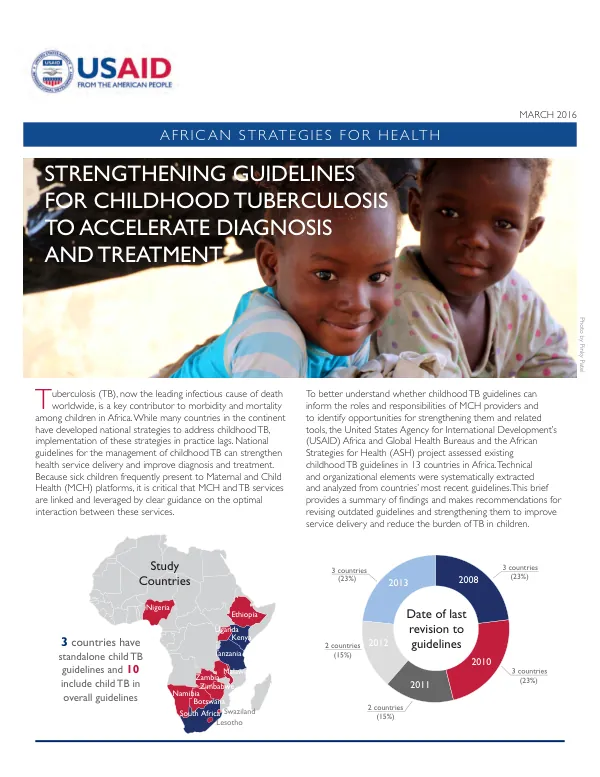
Many countries have developed national strategies to address childhood TB, but the implementation of these strategies lags. National guidelines for the management of childhood TB can strengthen health service delivery and improve diagnosis and treatment. It is essential that Maternal and Child Health (MCH) and TB services are linked and leveraged by clear guidance on the optimal integration between these services. In 13 countries in Africa, the United States Agency for International Development's (USAID) Africa and Global Health Bureaus and the African Strategies for Health (ASH) project assessed existing childhood TB guidelines. The assessment aimed to identify opportunities for strengthening guidelines and related guidelines and to inform the roles and responsibilities of MCH providers. The project extracted and analyzed the most recent guidelines from the 13 countries, focusing on technical and organizational elements. The assessment revealed that few guidelines reference common tools and services used for MCH or nutrition service delivery. Only a few guidelines mention Integrated Management of Childhood Illness (IMCI) or integrated community case management. However, some guidelines emphasize the importance of screening severely malnourished children for TB. The language used in guidelines can also influence providers' use of diagnostic approaches, with some guidelines promoting practices while acknowledging limitations, while others use negative language. Current guidelines are most useful at a hospital level, but they lack explicit reference to service organization and the use of MCH programs to identify and manage childhood TB. This limitation causes significant delay in diagnosis and treatment. The rhetoric of childhood TB may also discourage MCH providers from contributing effectively to childhood TB programming. The assessment identified several areas for strengthening guidelines, including the development of a comprehensive diagnostic approach, the description of diagnostic tests and methods, and the discussion of extrapulmonary TB. Guidelines should also outline isoniazid preventive therapy (IPT) indications, discuss TB-HIV co-infection, and incorporate algorithms for diagnosis and contact screening. Additionally, guidelines should address direct observed treatment, monitoring, and contact management, as well as provide indications for hospitalization and discuss management of adverse drug effects. The World Health Organization revised global recommendations for TB management in 2014, emphasizing the roles and responsibilities of health workers at various levels of the health system. National programs should update guidelines to reflect these changes, focusing on clear and specific roles and responsibilities by level and cadre, including MCH programs. Guidelines should also adopt and clarify rhetoric that encourages MCH providers to identify symptoms of childhood TB and reduce diagnostic delay.
Related documents