USAID DEC
Regional Actors Addressing HIV in Africa: Comparative Advantages, Challenges, and Opportunities
Sign inUSAID
Regional Actors Addressing HIV in Africa: Comparative Advantages, Challenges, and Opportunities
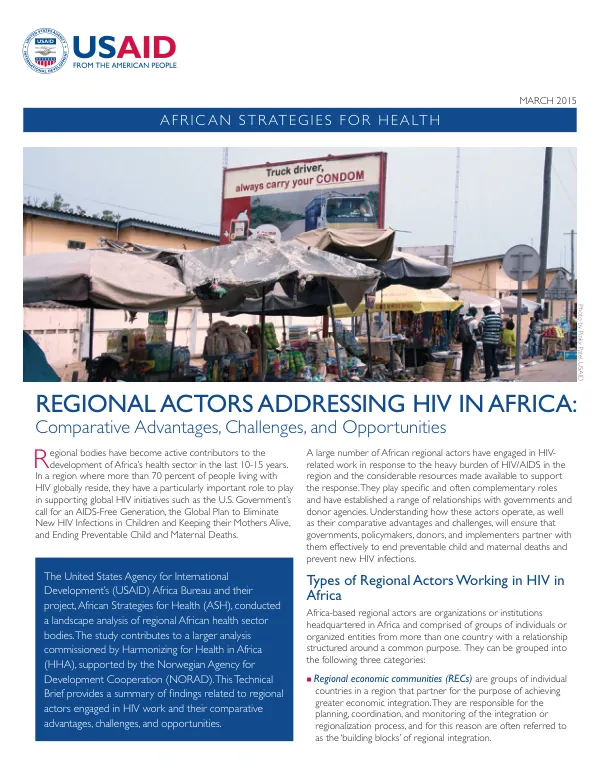
Regional economic communities (RECs) have become active contributors to the development of Africa's health sector in the last 10-15 years.
2015 · 4 pages
Sign in to readA free account is required to download.
Abstract
They have a particularly important role to play in supporting global HIV initiatives such as the U.S. Government's call for an AIDS-Free Generation, the Global Plan to Eliminate New HIV Infections in Children and Keeping their Mothers Alive, and Ending Preventable Child and Maternal Deaths. Africa-based regional actors are organizations or institutions headquartered in Africa and comprised of groups of individuals or organized entities from more than one country with a relationship structured around a common purpose. They can be grouped into three categories: RECs, regional networks and associations, and regional technical organizations. Regional economic communities are groups of individual countries in a region that partner for the purpose of achieving greater economic integration. They are responsible for the planning, coordination, and monitoring of the integration or regionalization process. RECs can use their convening power to host summits with the participation of high-level officials, during which regional strategic plans, frameworks, policies, and protocols can be proposed and endorsed or adopted by member states. Regional networks and associations include umbrella organizations for civil society organizations (CSOs), groups that bring together people living with HIV, advocates, health professionals, researchers, or policymakers, and groups of research and/or academic institutions. They often cite knowledge exchange, capacity building, and advocacy as their main objectives, and closely follow current thinking about HIV in order to disseminate HIV-related information, monitor the delivery of HIV services, represent the voice of the community, or advocate for HIV policies. Regional technical organizations bring together groups of people with deep technical expertise in HIV who understand the African context and can conduct research or provide guidance for transforming HIV commitments and decisions into technically sound, evidence-based HIV interventions. They serve as repositories for innovative HIV research, best practices, and state of the art. Regional actors have several comparative advantages in addressing HIV in Africa. One of these advantages is convening power, which allows them to bring together African countries at the highest political level to discuss and make commitments on HIV-related issues. For example, the African Union convened leaders to the African Union Special Summit in July 2013 to commit to the elimination of HIV and AIDS, tuberculosis, and malaria in Africa by 2030. Another advantage is policy harmonization, which is essential in addressing HIV, as the disease knows no borders. Regional economic communities can use their convening power to host summits with the participation of high-level officials, during which regional strategic plans, frameworks, policies, and protocols can be proposed and endorsed or adopted by member states. Regional actors also have the advantage of pooling expertise, which allows them to leverage the collective expertise, experience, knowledge, and skills of professionals from different countries and diverse settings. They serve as repositories for innovative HIV research, best practices, and state of the art. Finally, regional actors can be powerful HIV advocates because they comprise multiple members across many countries and can elevate policy issues that might otherwise not receive attention. They can provide an outlet for the sharing of experiences, exposing of restrictive environments and challenges, and a call for policy change in unison with many other voices from many other countries. Examples of regional actors that have demonstrated these advantages include the Organization of African First Ladies Against HIV/AIDS (OAFLA), the Southern African Development Community's (SADC) HIV and AIDS Strategic Framework, the Health Economics and HIV & AIDS Research Division (HEARD), the Southern Africa HIV and AIDS Information Dissemination Service (SafAIDS), the African Network for Care of Children Affected by HIV/AIDS (ANNECCA), and African Men for Sexual Health and Rights (AMSHeR).
Related documents