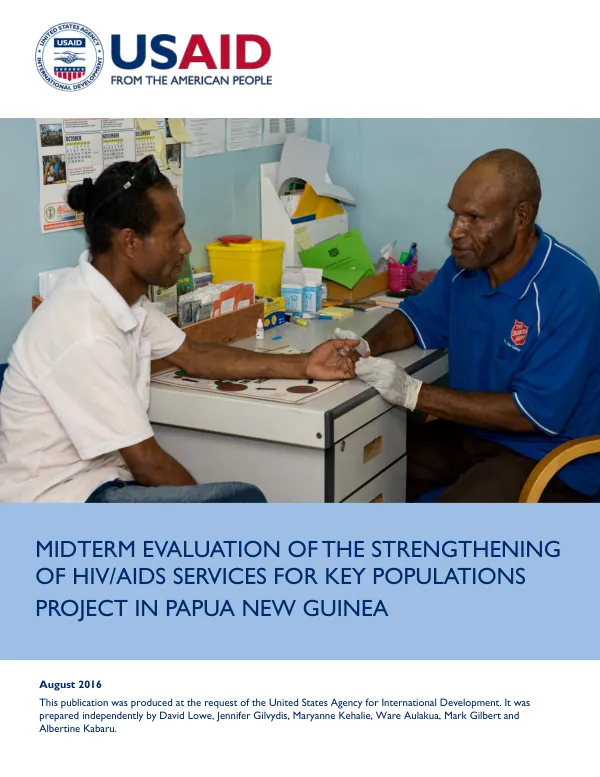
DEPARTMENT OF HEALTH
Strengthening HIV /AIDS Services for MARPS in PNG Program
The "Strengthening HIV/AIDS Services for MARPS in PNG Program" was launched in the first quarter of Fiscal Year 2013 by FHI 360 Papua New Guinea.
2013 · 30 pages
Sign in to readA free account is required to download.
Abstract
The five-year project, funded by the United States Agency for International Development (USAID) Pacific Islands, aims to increase demand for HIV/AIDS services by most-at-risk populations (MARPs), their sexual partners, and their families. The project is based in Papua New Guinea and managed by USAID/Philippines, with a consortium of FHI 360 and seven local implementing agencies. The project's key tasks during the first quarter of FY13 included completing Pre-Award Reviews for six of the seven implementing agencies, providing technical assistance on project start-up to FHI 360 PNG country office staff, and conducting meetings and negotiations with five of the seven implementing agencies to develop FY13 scopes of work and budgets. The FY13 Annual Implementation Plan (AIP) and the five-year Performance Management Plan (PMP) were completed and submitted to USAID. The major focus during the first quarter was completion of key start-up activities to ensure smooth project implementation. This included Pre-Award Assessments conducted by the FHI 360 finance team with six implementing agencies to determine the financial health of these new partners. The FHI 360 country office also filled all key project positions, including recruiting Ms. Delphine Nuia as HIV/AIDS Service Delivery Advisor. The FHI 360 PNG team received a series of technical assistance (TA) visits during October and November from FHI 360 APRO staff. These visits included strategic planning and award overview, program review, and development of the project's 5-year M&E plan. Following these visits, FHI 360 PNG revised some organizational and project structures to ensure optimal delivery of project outcomes. The project has four objectives: to increase demand for HIV/AIDS services by MARPs, their sexual partners, and their families; to increase supply of HIV/AIDS services for MARPs, their sexual partners, and their families; to increase use of facility- and community-based gender and gender-based violence (GBV) interventions; and to strengthen health systems for HIV/AIDS service delivery. During the first quarter, the FHI 360 team catalogued existing Social and Behavior Change Communication (SBCC) materials targeting MARPs and reviewed lessons learned from projects in other concentrated epidemics. The existing FHI 360 PNG SBCC strategy will be updated with all local partners, including faith-based organizations, to incorporate the latest information on the epidemic and to accommodate the major components of the new MARPs project. The FHI 360 team also organized meetings with implementing agencies and key stakeholders, including the National Department of Health, the National AIDS Council Secretariat, and the NCD Department of Health, to orient them to the new USAID project and to generate understanding and consensus among all stakeholders on project aims, roles, and responsibilities. Service delivery under the new project will begin in Q2. The FHI 360 team contributed to national discussions and policy development through participation in technical working group (TWG) meetings organized by NDOH, NACS, and NCD Health. The team also promoted gender during World AIDS Day by displaying photos from the Powerful Voices exhibition created by FHI 360 and Sirus Naraqi Foundation, to promote gender and empower women in two communities in NCD. The project has submitted approval for the procurement of clinical equipment and CD 4 machine to USAID. The CD 4 machine will supplement early start of treatment for PLHIV while the clinical equipment will be used for STI and opportunistic infection diagnosis and treatment. The summary table below summarizes achievements by IR during the reporting period. Activities listed are based on those outlined in the approved FY13 workplan, a separate table is included listing start-up activities undertaken during this period. Planned activities Indicators Yearly target Achievement during reporting period Planned expenditure (USD) Actual expenditure (USD) Objective 1 (IR 2.1): To increase demand for HIV/AIDS services by MARPs, their sexual partners, and their families Activity 1.1.3: Adapt and develop new innovative and MARP-appropriate SBCC materials N/A On-going: a review of existing materials is being carried out to inform adaptation and development $139,754.39 $79,307.48 Activity 1.1.4: Distribute the 1 Taim U: blo...