USAID DEC
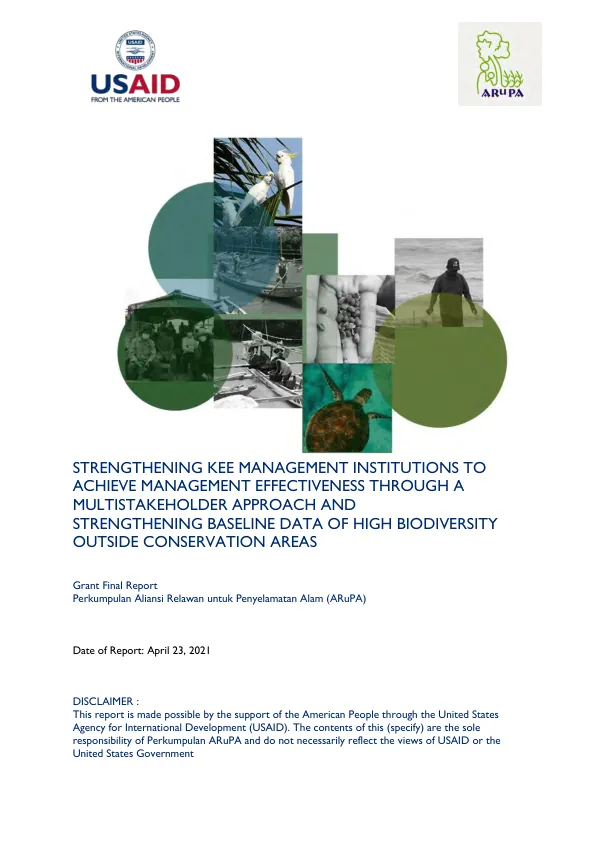
Strengthening KEE Management Institutions to Achieve Management Effectiveness through a Multistakeholder Approach and Strengthening Baseline Data of High Biodiversity Outside Conservation Areas
Sign inCHEMONICS
Strengthening KEE Management Institutions to Achieve Management Effectiveness through a Multistakeholder Approach and Strengthening Baseline Data of High Biodiversity Outside Conservation Areas
The main purpose of the grant was to improve the effectiveness of KEE management at the field level by promoting a multistakeholder management approach.
2021 · 36 pages
Sign in to readA free account is required to download.
Abstract
The grant activity was implemented by working with stakeholders to strengthen KEE management institutions, strengthen the KEE management documents according to effectiveness measurements, conduct analysis of KEE management financing options from local government agencies and stakeholders, and determine the roles and responsibilities, and working relationship between involved stakeholders. The grant focused on four key objectives: assessing the need for strengthening the institution of the KEE multi-stakeholder forum, strengthening the institutional functions to achieve the effectiveness of KEE management, increasing the capacity of forum members and community groups in managing KEE, and implementing the inventory of high biodiversity areas outside the conservation area. To achieve these objectives, ARuPA carried out several activities, including consolidation meetings, research, multi-stakeholder workshops, training, and mapping and field verification. The grant was implemented in two phases. Phase I took place from May to November 2020, focusing on KEE Teluk Pangpang in Banyuwangi. Phase II took place from December 2020 to April 2021, focusing on four additional KEE locations: KEE Mangrove Ujungpangkah in Gresik, KEE Pantai Taman Kili Kili in Trenggalek, KEE Pulau Masakambing in Sumenep, and KEE Teluk Pangpang in Banyuwangi. The grant also worked to strengthen the process of identification and verification of high biodiversity areas outside conservation areas in East Java. The selected pilot locations were in KEE Teluk Pangpang in Banyuwangi, KEE Ujung Pangkah in Gresik, KEE Pantai Taman Kili-kili in Trenggalek, and KEE Masakambing in Sumenep. The grant also worked to strengthen the process of identification and verification of high biodiversity areas outside conservation areas in East Java. The biodiversity inventory will strengthen the achievement of the East Java Province target to identify and verify 225,000 hectares of high biodiversity areas. The grant was implemented by ARuPA in collaboration with the East Java Office for Natural Resources Conservation (BBKSDA) and East Java Forestry Service (Dinas Kehutanan). The grant was funded by USAID and was implemented from May 2020 to April 2021. The grant was successful in achieving its objectives, and the new approach taken by ARuPA at the KEE Teluk Pangpang has been approved by East Java BBKSDA and Forestry Service.