USAID DEC
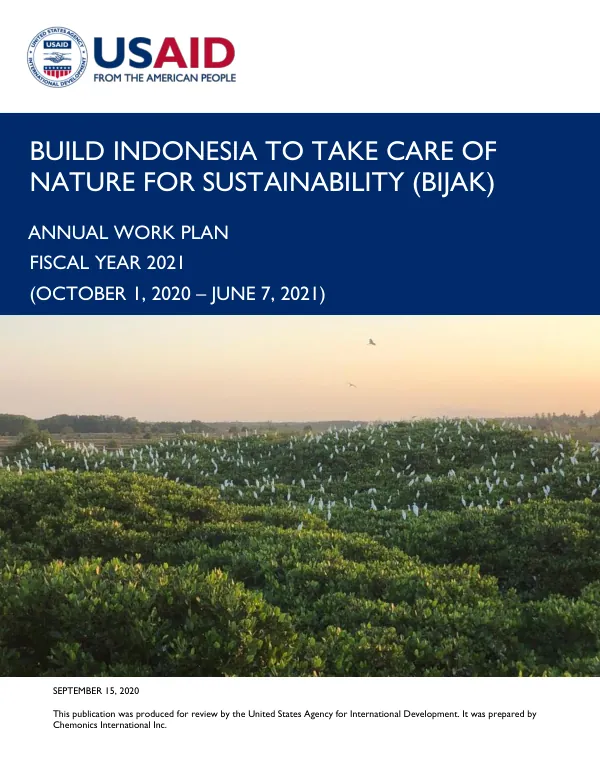
BUILD INDONESIA TO TAKE CARE OF NATURE FOR SUSTAINABILITY (BIJAK) ANNUAL WORK PLAN FY 2021
Sign inCHEMONICS
BUILD INDONESIA TO TAKE CARE OF NATURE FOR SUSTAINABILITY (BIJAK) ANNUAL WORK PLAN FY 2021
The USAID BIJAK project is a five-year initiative aimed at promoting sustainable practices in Indonesia.
2021 · 76 pages
Sign in to readA free account is required to download.
Abstract
The project focuses on reducing greenhouse gas emissions and conserving marine and terrestrial biodiversity. To achieve this goal, BIJAK works at the national level, engaging with various stakeholders to improve forest management and conservation area protection, as well as strengthen protections for threatened marine and terrestrial wildlife. The project's approach is centered on promoting enduring changes in individual and organizational behaviors. This is achieved through a range of activities, including training programs, infrastructure development, and market linkage facilitation. The project also places a strong emphasis on community engagement and feedback, with a focus on empowering local communities to take ownership of conservation efforts. One of the key areas of focus for BIJAK is the development of sustainable forest management practices. The project works with local communities, government agencies, and other stakeholders to promote the adoption of sustainable forest management techniques, such as reforestation and agroforestry. This approach aims to reduce deforestation and promote the conservation of valuable forest ecosystems. In addition to forest conservation, BIJAK also focuses on protecting marine biodiversity. The project works with local communities, government agencies, and other stakeholders to promote the conservation of marine ecosystems, including coral reefs and mangrove forests. This is achieved through a range of activities, including the establishment of marine protected areas and the promotion of sustainable fishing practices. The project also places a strong emphasis on community engagement and feedback. BIJAK works closely with local communities to understand their needs and concerns, and to develop conservation strategies that are tailored to their specific contexts. This approach aims to promote a sense of ownership and responsibility among local communities, and to ensure that conservation efforts are effective and sustainable in the long term. The USAID BIJAK project is a collaborative effort involving a range of stakeholders, including government agencies, non-governmental organizations, and local communities. The project is implemented in partnership with the Government of Indonesia, and works closely with a range of national and local institutions to achieve its goals. The project's activities are guided by a range of technical themes, including forest conservation, marine conservation, and community engagement. These themes are reflected in the project's work plan, which outlines the specific activities and outcomes that the project aims to achieve over the course of the next year. The project's work plan is also informed by a range of cross-cutting themes, including gender integration, special activities, and activity coordination. These themes are reflected in the project's approach to community engagement, and aim to ensure that the project's activities are inclusive and effective in promoting sustainable conservation practices. Overall, the USAID BIJAK project is a comprehensive initiative aimed at promoting sustainable practices in Indonesia. The project's focus on community engagement, sustainable forest management, and marine conservation makes it an important contribution to the conservation of Indonesia's rich biodiversity.
Related documents