USAID DEC
Strengthening Resilience and Disaster Risk Reduction Capabilities in the Vulnerable Communities of Pichincha, Carchi and Sucumbíos in Ecuador
Sign inADVENTIST DEVELOPMENT AND RELIEF AGENCY INTERNATIONAL
Strengthening Resilience and Disaster Risk Reduction Capabilities in the Vulnerable Communities of Pichincha, Carchi and Sucumbíos in Ecuador
The project "Reinforcing Resilience and Disaster Risk Reduction Capacities in Vulnerable Communities from Pichincha, Carchi and Sucumbíos in Ecuador" aims to strengthen disaster risk reduction and resilience of more than 7,000 people in vulnerable communities from the indicated provinces.
2020 · 54 pages
Sign in to readA free account is required to download.
Abstract
The program is based on best practices and lessons learned from the previous program funded by OFDA, "Estamos Preparados Ecuador." ADRA implemented this program in the provinces of Manabí and Esmeraldas. The project contributes to strengthening the National Decentralized Risk Management System (SNDGR) because its design responds to the priorities of the National Service Risk Management and Emergency (SNGRE), the governing body of the Managing Disaster Risk in Ecuador. The interventions of the program include training and education, development of tools for disaster risk reduction, establishment of local networks of risk reduction, formation of community brigades, awareness events, strengthening of Emergency Operations Committees (COEs) of the municipalities, and community mobilization to develop a local disaster risk reduction culture. The project focuses on three municipalities in the provinces of Carchi, Sucumbíos, and Pichincha: Tulcán, Lago Agrio, and Quito, respectively. The needs recognized in the field evaluation carried out by ADRA for the formulation of the project include strengthening the technical capabilities of the Municipal Risk Management Units, supporting the implementation of disaster risk reduction agendas, developing and/or strengthening the Community Risk Management Committees (CCGR) in accordance with the new Guide and the new regulations, developing and/or strengthening community risk management networks, and developing the capacities of the members of the Cantonal Emergency Operations Committees based on the new guidelines of the National Disaster Response Plan and the Manual of the Emergency Operations Committee (COE). The project foresees the following results: municipal, community, and neighborhood committees strengthen their capacities to respond adequately to emergencies and disasters independently and in coordination with municipal entities, municipalities strengthen their capacity for disaster response preparedness, through programs and initiatives prioritized by SNGRE, and teachers and students of Educational Institutions strengthen their capacities to reduce disaster risks through the application of awareness programs, training, and participation with recreational and leisure methodologies. The execution of the project implies a process that synchronizes the available resources with the programmatic proposal. The project must fulfill three phases that allow its adequate management: the preparatory phase, the implementation phase, and the closing phase. The preparatory phase is essential because it is there that the project is organized to efficiently meet the objectives and expected results. This organization includes a planning exercise that contains the Baseline whose objective is to identify the situation, at the beginning of the project, of the programmatic aspects so that through the monitoring of the variables and indicators identified the achievements at the end of the project and the progress in its development can be compared. The Baseline study was carried out to identify the situation at the beginning of the project with regard to the proposed indicators, in order to produce a comparative analysis of the achievements at the end of the project. The study was conducted in the three provinces of Pichincha, Carchi, and Sucumbíos, and it included the collection of information through surveys, interviews, and other methods. The study aimed to identify the current situation of the communities in terms of disaster risk reduction and resilience, and to establish a baseline for the project's monitoring and evaluation. The study found that the communities in the three provinces are vulnerable to natural hazards such as earthquakes, volcanic eruptions, floods, landslides, and forest fires. The study also found that the institutional and community disaster preparedness action is very low or non-existent in the three provinces. The study recommended the implementation of disaster risk reduction initiatives with a holistic approach that considers the different local actors, including educational institutions and other entities involved. The project's methodology includes the use of indicators and topics to investigate in surveys and interviews by sector and sources. The study used a mixed-methods approach, combining both qualitative and quantitative data collection and analysis methods. The study's findings will be used to inform the project's implementation and to monitor its progress and achievements. The project's results will contribute to strengthening the resilience and disaster risk reduction capacities of the communities in the three provinces. The project's expected outcomes include the strengthening of municipal, community, and neighborhood committees, the strengthening of municipalities' capacity for disaster response preparedness, and the strengthening of teachers and students' capacities to reduce disaster risks. The project's results will also contribute to the strengthening of the National Decentralized Risk Management System (SNDGR) and the National Service Risk Management and Emergency (SNGRE).
Related documents
Documents in this collection
 2020
2020USAID DEC
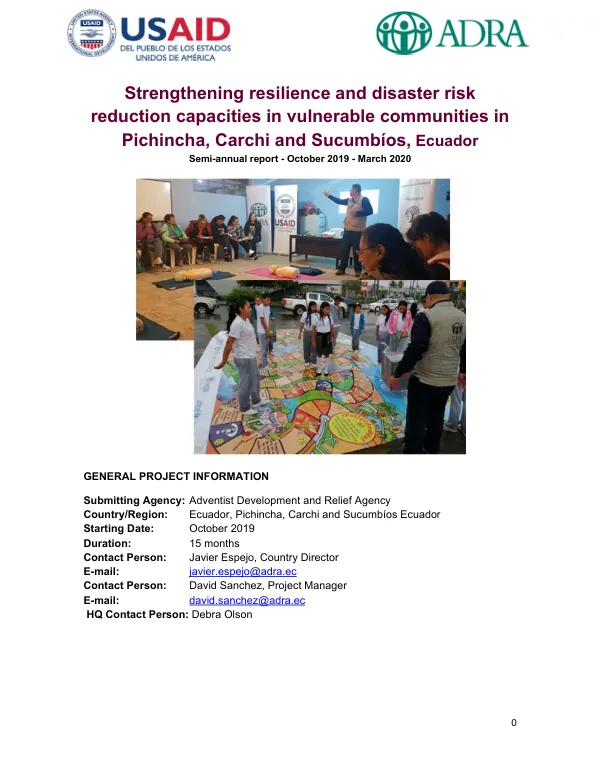
Strengthening resilience and disaster risk reduction capacities in vulnerable communities in Pichincha, Carchi and Sucumbíos, Ecuador Semi-annual report - October 2019 - March 2020
Open record 2020
2020USAID DEC