USAID DEC
Strengthening Resilience and Disaster Risk Reduction Capacities in Vulnerable Communities in Ecuador
Sign inADVENTIST DEVELOPMENT AND RELIEF AGENCY INTERNATIONAL
Strengthening Resilience and Disaster Risk Reduction Capacities in Vulnerable Communities in Ecuador
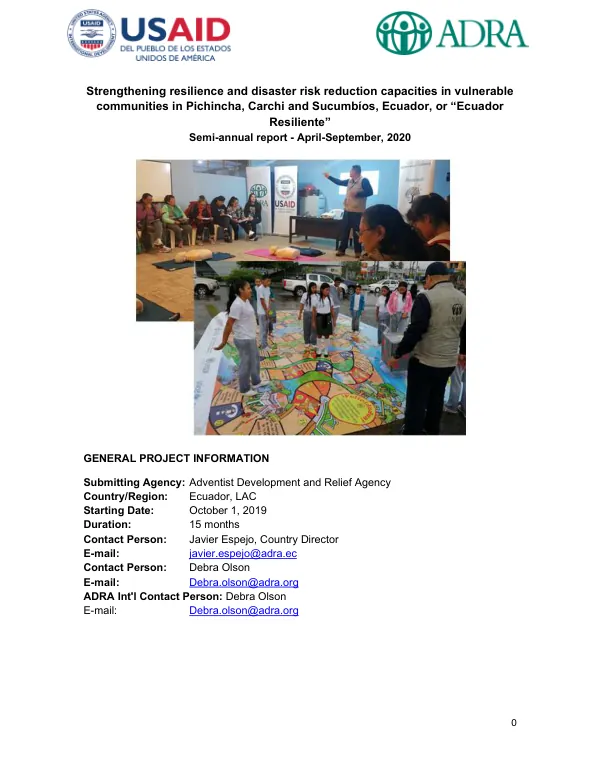
The Ecuador Resiliente project aims to strengthen disaster risk reduction (DRR) and resilience capacities in vulnerable communities in Pichincha, Carchi, and Sucumbíos, Ecuador.
2020 · 13 pages
Sign in to readA free account is required to download.
Abstract
The project targets 7,180 people and focuses on increasing awareness and preparedness of communities and households to cope with disasters. Interventions include training and education programs, development of DRR tools, establishment of local networks for DRR, formation of community brigades, awareness events, and strengthening of Emergency Operations Committees (COE) and Risk Management Units (RMU). Training and education programs were initially designed to take place in-person but were modified to virtual platforms due to the COVID-19 pandemic. Despite challenges, activities with neighborhoods and formation of community risk management committees and their corresponding brigades have been successful. The number of people participating in training exceeded the target, with 874 people reached in the reporting period, compared to the target of 662. The percentage of people trained who retain skills and knowledge after two months is in process, with assessments to be conducted from October 20 to November 15, 2020. Capacity building and training activities were delayed due to waiting on new approvals from the Ministry of Education required in the context of COVID-19. Once the activities began, they were conducted virtually, allowing for more teachers to be reached at more educational institutions in less sessions. Trainings included disaster risk reduction and institutional risk reduction plans (PIRR). The development of a mobile application and certification courses was also carried out, representing an important technical and logistical development. The training of youth and school-age children in DRR through the establishment of groups called "Pioneros" was also conducted. The number of people trained in disaster preparedness, risk reduction, and management exceeded the target, with 594 people reached in the reporting period, compared to the target of 180. The number of people passing final exams or receiving certificates is in progress, with assessments to be conducted from October 20 to November 15, 2020. The percentage of people trained who retain skills and knowledge after two months is in process, with a target of 70%. The number of community brigades formed and strengthened exceeded the target, with 24 brigades formed in the reporting period, compared to the target of 24. The project has made significant progress in strengthening DRR and resilience capacities in vulnerable communities in Ecuador. The project's interventions have been adapted to the context of the COVID-19 pandemic, and efforts have been made to reach a wider audience through virtual platforms. The project's technical and logistical developments, such as the development of a mobile application and certification courses, are essential for compliance and will contribute to the project's overall objectives.
Related documents
Documents in this collection
 2020
2020USAID DEC
Strengthening Resilience and Disaster Risk Reduction Capabilities in the Vulnerable Communities of Pichincha, Carchi and Sucumbíos in Ecuador
Open record 2020
2020USAID DEC