USAID DEC
Strengthening resilience and disaster risk reduction capacities in vulnerable communities in Pichincha, Carchi and Sucumbíos, Ecuador Semi-annual report - October 2019 - March 2020
Sign inADVENTIST DEVELOPMENT AND RELIEF AGENCY INTERNATIONAL
Strengthening resilience and disaster risk reduction capacities in vulnerable communities in Pichincha, Carchi and Sucumbíos, Ecuador Semi-annual report - October 2019 - March 2020
The disaster risk reduction and resilience program in Ecuador began in October 2019 with the goal of strengthening the disaster risk reduction capacities of vulnerable communities in Pichincha, Carchi, and Sucumbíos provinces.
2020 · 15 pages
Sign in to readA free account is required to download.
Abstract
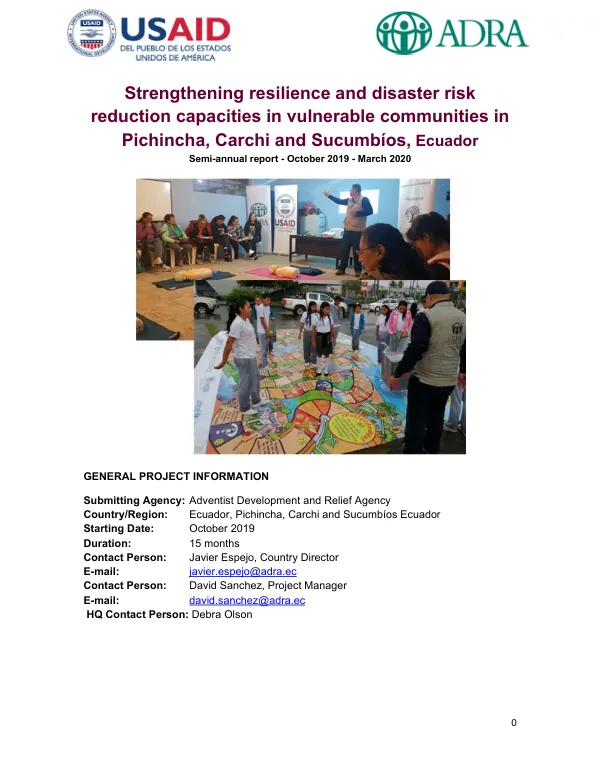
The program aims to increase awareness and preparedness of communities and households to cope with disasters through various interventions, including training and education programs, development of disaster risk reduction tools, establishment of local risk reduction networks, formation of community brigades, awareness events, and strengthening of municipal Emergency Operations Committees. The program's activities in the first quarter of 2020 focused on building community awareness and mobilization in the parroquia of Tufiño, Carchi Province. Meetings were held with the representative of the SNGRE in Tulcán, and an informative forum "Living among volcanoes" was organized, which brought together the community of Tufiño, students of the Educational Institution, and personnel of the military garrisons. The forum identified the needs of the community, including signage and visual aids for evacuation routes and necessary items in case of an emergency. In the parroquia of Tufiño, the coordination of the launch of the project and the formation of the "COPAE" (Parroquia Commission for Emergency Attention) was carried out in the communal house. ADRA participated together with the National Service of Risk and Emergency Management (SNGRE), the Prefecture of Carchi, local response institutions, the Army, and the Police, and with the presence of the presidents of the communities of Tufiño. The competencies and importance of forming a COPAE were presented, and the formation of the same was carried out with the authorities present. In the area of Sucumbíos, meetings were held with the parroquia board to begin the process of identifying communities and neighborhoods where the activities will be developed. A meeting was also held with the director of the "Unidad Educativa del Milenio Dr. Camilo Gallegos Domínguez", showing interest in the participation of the educational unit in the activities of the project. In the area of General Farfán, it was coordinated with the president of the parroquia council that the most at-risk communities are Fuerzas Unidas, Zozoranga, 18 de noviembre, Puerto Mestanza, Barrio Central, and Barrio Bella Vista. The program's technical results in the first quarter of 2020 include the formation of the COPAE in the parroquia of Tufiño, the coordination of the launch of the project, and the identification of communities and neighborhoods where the activities will be developed. The program has also made progress in building community awareness and mobilization, with 136 participants completing Basic First Aid training. However, the program has not yet reached its cumulative targeted number of 45 participants in the Building Community Awareness/Mobilization sub-sector. The program's geographic area of intervention includes the provinces of Pichincha, Carchi, and Sucumbíos in Ecuador. The program's activities are focused on building community awareness and mobilization, strengthening community risk management and reduction capacities, and establishing local risk reduction networks. The program's technical results are being monitored and evaluated through the use of indicators, including the number of people participating in training, the percentage of people trained who retain skills and knowledge after two months, and the percentage of attendees at joint planning meetings who are from the local community.
Related documents