DELOITTE CONSULTING, LLP
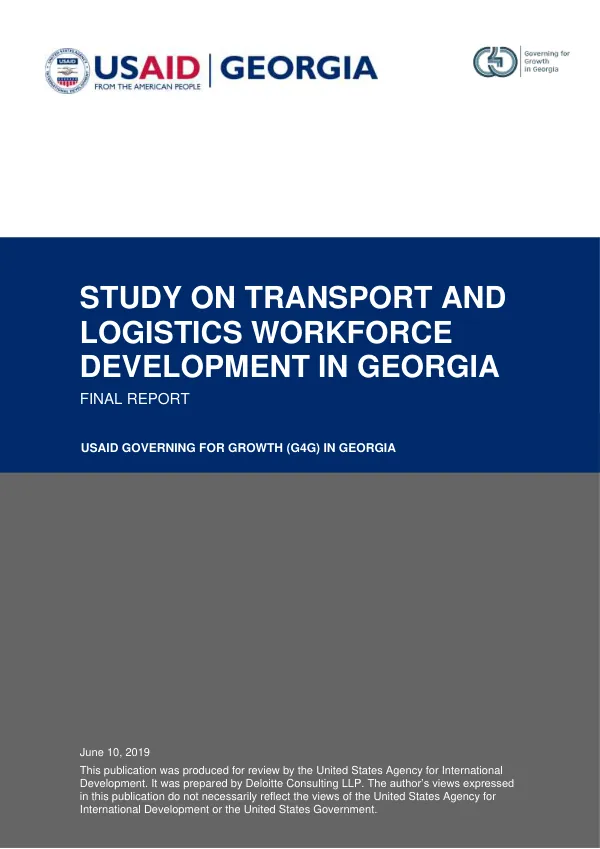
Study on Transport and Logistics Workforce Development in Georgia
Transport and Logistics Workforce Development in Georgia began with an assessment of competency needs in the industry.
2019 · 48 pages
Sign in to readA free account is required to download.
Abstract
The assessment identified gaps in the skills and knowledge of operative staff, administrative staff, logistics supervisors, and logistics managers. Operative staff lacked training in areas such as cargo handling, transportation, and safety procedures. Administrative staff required training in areas such as logistics management, supply chain management, and customer service. Logistics supervisors and managers needed training in areas such as strategic planning, risk management, and leadership. Stakeholders in workforce education and skills development were identified as companies, vocational education schools, higher education programs, logistics associations, and professional development and certification programs. Companies were found to be investing in training and development programs for their employees, but these programs were often limited in scope and duration. Vocational education schools were providing training in areas such as truck driving, logistics, and supply chain management, but the quality of these programs was variable. Higher education programs were offering degrees in logistics and supply chain management, but these programs were often theoretical in nature and did not provide students with practical skills. A gap analysis was conducted to identify the gaps in the skills and knowledge of the workforce. The analysis found that the workforce lacked training in areas such as transportation management, logistics planning, and supply chain management. The analysis also found that the workforce lacked experience in areas such as international trade, customs procedures, and transportation regulations. Human resource management and policies were also examined. The study found that recruitment and staff acquisition difficulties were a major challenge for companies in the transport and logistics industry. Candidates selection and employment process constrains were also identified as a major challenge. The study recommended that companies invest in training and development programs for their employees to improve their skills and knowledge. The state and private sector roles in the transport and logistics workforce development facilitation were also examined. The study found that the state-owned VET Center for Truck Drivers was providing training in areas such as truck driving and logistics. The Ministry of Education, Science, Culture and Sport of Georgia was also involved in the transport and logistics workforce development process. Labor market state research and skills anticipation were also identified as a major challenge. Demand forecast of future jobs in transport and logistics was also examined. The study found that the demand for logistics and supply chain professionals was expected to increase in the coming years. The study recommended that companies invest in training and development programs for their employees to improve their skills and knowledge. Recommendations were made to address the gaps in the skills and knowledge of the workforce. The recommendations included investing in training and development programs for employees, improving the quality of vocational education programs, and increasing the number of higher education programs in logistics and supply chain management. The recommendations also included improving the recruitment and selection process, and increasing the involvement of the state and private sector in the transport and logistics workforce development process. The Logistics Performance Index (LPI) was used to assess the logistics performance of Georgia. The LPI is a measure of the logistics performance of countries around the world. The LPI assesses the efficiency of the logistics system, the quality of logistics services, and the level of logistics infrastructure. The LPI was used to identify areas for improvement in the logistics performance of Georgia. The study found that the logistics performance of Georgia was below the regional average. The study recommended that the government invest in improving the logistics infrastructure, increasing the efficiency of the logistics system, and improving the quality of logistics services. The study also recommended that companies invest in training and development programs for their employees to improve their skills and knowledge. The study concluded that the transport and logistics workforce development in Georgia was a major challenge. The study recommended that the government and private sector invest in training and development programs for employees, improve the quality of vocational education programs, and increase the number of higher education programs in logistics and supply chain management. The study also recommended that companies invest in improving the recruitment and selection process, and increasing the involvement of the state and private sector in the transport and logistics workforce development process.
Related documents