DELOITTE CONSULTING, LLP
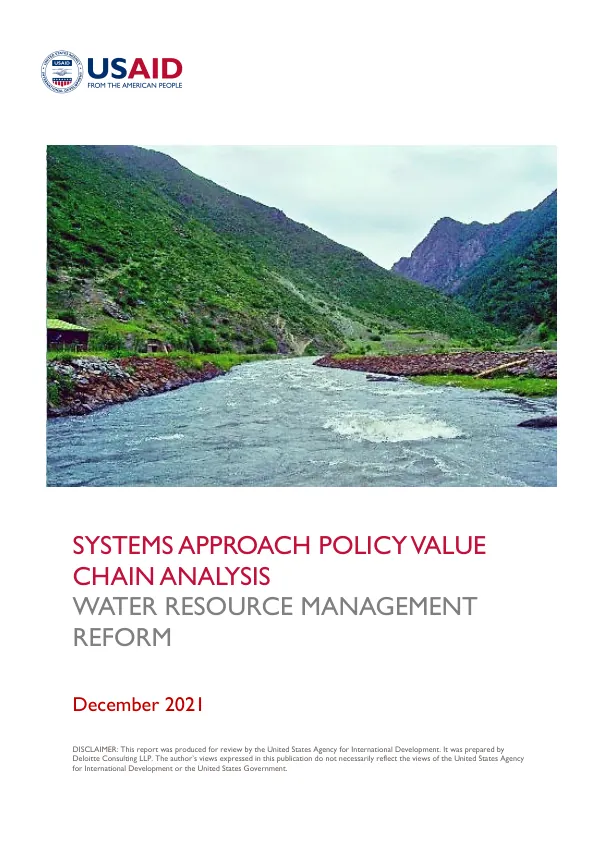
Systems Approach Policy Value Chain Analysis - WRM Reform
Improved water resources management can have a fundamental impact on a country's economic growth as it contributes significantly to increased production and productivity within different economic sectors.
2021 · 32 pages
Sign in to readA free account is required to download.
Abstract
According to the United Nations, "a $15-30 billion investment in improved water resources management in developing countries can have direct annual income returns in the range of $60 billion. Every $1 invested in watershed protection can save anywhere from $7.50 to nearly $200 in cost for new water treatment and filtration facilities." Georgia's poor water management system has long been a major regulatory bottleneck for the country's economic development. Existing institutional and legal framework is inconsistent, contradictory, and fragmented. The Water Law of 1997 defines the main objectives and principles of water policy, but it is outdated and does not provide the legal framework to tackle the existing challenges in the water sector. At present, there is no control of wastewater and water abstraction as its licensing and permitting were abolished. Moreover, there are no mechanisms to promote efficient water use and prevent industrial or household water pollution. Likewise, the country lacks mechanisms to regulate the allocation and distribution of water when conflicts between consumers/communities arise. Georgia and neighboring Azerbaijan share two major water sources, the Mtkvari/Kura and Alazani rivers. There is growing awareness in both countries that steps should be taken to avoid conflicts over water use. In addition, Georgia lacks strong water-related data, which complicates proper planning and decision making on water-related issues. The Ministry of Environmental Protection and Agriculture (MEPA), with USAID support, developed the draft Water Resource Management Law (the draft Law) to meet the requirements under the EU-Georgia DCFTA legislative approximation process. The draft Law completely reshapes Georgia's water management system and introduces several novelties to make the system more effective. It introduces river basin management (RBM) and economic instruments of water use (e.g., permitting and licensing). It also improves the water monitoring framework and provides water pollution prevention measures. Furthermore, the draft Law significantly strengthens the role of municipalities and ensures Government of Georgia (GOG) agencies will act in coordination with each other. The regulatory impact assessment (RIA) found that the proposed changes, including the introduction of permitting and a fee system as well as the establishment of water quality standards, will have a positive long-term impact on Georgia's economy. Using a Systems Approach Policy Value Chain Analysis methodology that draws from Political Economy Analysis (PEA) and root cause analysis, this report explores conditions for the successful implementation of the draft Law, such as sustainable use of water resources and sufficient water quality. It also analyzes key stakeholders. The main challenges identified in the reform process include the absence of clear regulations on water use, the absence of river basin management plans (RBMP), poor water-related data, lack of adequate human resources and capacity at the central and local levels of government, weak coordination between the central and local levels of government, unclear delegation of responsibilities between the central and local levels of government, and the absence of economic instruments regulating water allocation. Key stakeholders in the reform process include MEPA, the Ministry of Regional Development and Infrastructure (MRDI), the Ministry of Economy and Sustainable Development (MoESD), municipalities, Civil Society Organizations (CSOs), and at some critical stages of the reform process, Parliament. MEPA is the main driver and the author of the draft Law. The Program identified and approached different stakeholders during the assessment (see Annex I: List of Stakeholders and Sources), whose opinions were carefully considered during the development of the report. Prioritized activities for the successful implementation of the reform include supporting the adoption of the draft Law, facilitating advocacy to adopt the WRM Law in Parliament, developing secondary legislation, building capacity of municipalities, and helping MEPA to develop continuous and consistent awareness raising and educational and professional trainings/workshops for municipalities to ensure the maximum effectiveness and efficiency of their work. The reform has strong support from MEPA, donors, and CSOs. General facts on water management issues in Georgia include the loss of 42% of the water introduced into the Georgian drinking water system, the loss of up to 50% of the water used for irrigation, and the treatment of only 26% of wastewater despite water collection systems being in place for 70% of Georgia's urban population.
Related documents